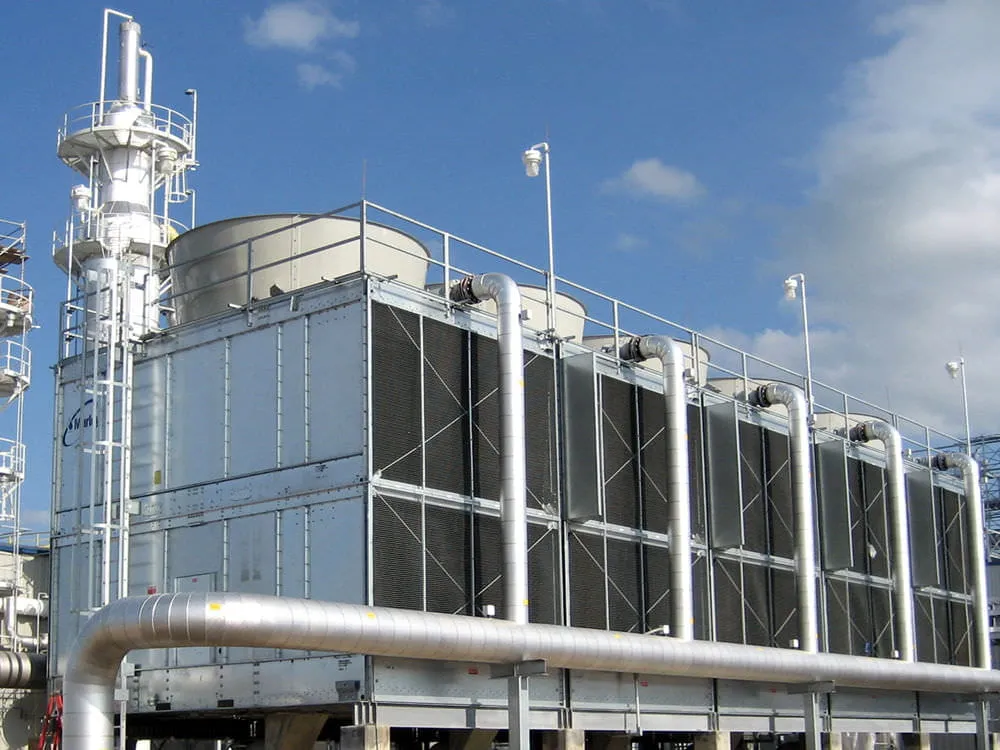
Cooling towers are the quiet workhorses of industrial refrigeration and process cooling, running continuously, rejecting heat that would otherwise shut a plant down, and rarely getting attention until something goes wrong. Because a cooling tower evaporates water continuously and is open to the atmosphere, it is also one of the most biologically and chemically active pieces of water-handling equipment on an industrial site. This guide covers what a cooling tower actually does, the failure mechanisms that untreated water causes, and how the major chemical categories work together to keep the system running efficiently and safely.
What Is a Cooling Tower
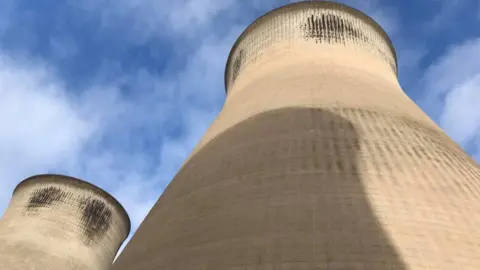
A cooling tower is a heat rejection device that transfers waste heat from a process or building's chiller system into the atmosphere, primarily through the evaporation of a small portion of the circulating water. Unlike a closed-loop chiller, a cooling tower's water circuit is open to outside air, which is precisely why it can reject heat so efficiently, and precisely why it is exposed to airborne dust, organic matter, and microorganisms that a fully closed system never encounters.
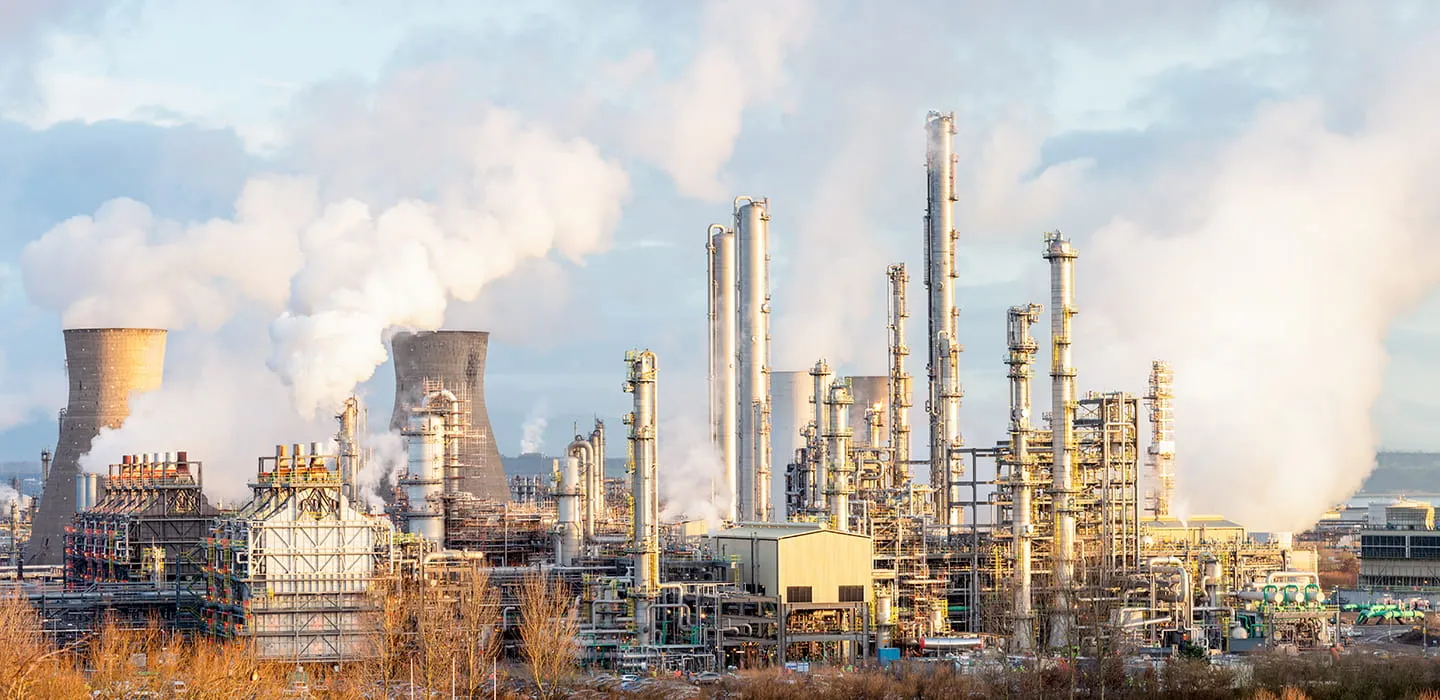
Industrial facilities across Bangladesh (textile dyeing plants, garment finishing lines, pharmaceutical manufacturing, food and beverage processing, and power generation) all rely on cooling towers to keep process equipment, chillers, and air conditioning systems within their operating temperature range. The tower itself is simple in concept, but the water circulating through it is anything but simple to manage without a proper treatment program.
How Cooling Towers Work
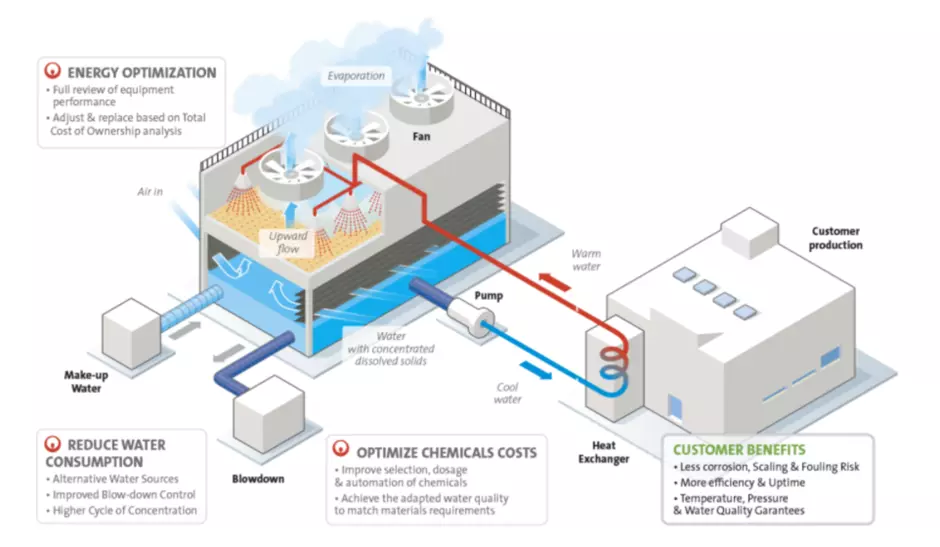
Warm water from the condenser or process heat exchanger is distributed across a fill media inside the tower, where it is broken into thin films or droplets to maximize surface area. Air is drawn or forced through this fill (either by natural draft or, far more commonly in industrial settings, by mechanical fans), and a small fraction of the water evaporates, carrying heat away with it. The cooled water collects in a basin at the base and is pumped back to the process, while makeup water replaces what was lost to evaporation, drift, and blowdown.
Importance of Water Treatment
Every gallon of water that evaporates leaves its dissolved minerals behind in the remaining water, meaning cooling tower water concentrates continuously in a way that closed-loop systems do not experience. Left untreated, this concentration effect drives scale formation, accelerates corrosion, and creates ideal conditions for biological growth, all three of which reduce heat transfer efficiency and, in the case of biological growth, create genuine health and regulatory concerns. A properly designed water treatment program is what keeps a cooling tower operating at its intended efficiency for its full service life instead of degrading quietly in the background.
Scale Formation
Scale forms when dissolved minerals, primarily calcium carbonate, exceed their solubility limit as cooling tower water concentrates through repeated evaporation cycles, precipitating onto heat exchanger surfaces, fill media, and piping. Scale is a poor conductor of heat compared to the metal or plastic surfaces it coats, so even a thin layer meaningfully reduces heat transfer efficiency and forces the system to work harder to achieve the same cooling result.
Corrosion
Corrosion in a cooling tower system is driven by dissolved oxygen (which is abundant, since the system is open to atmosphere), pH excursions, and the presence of chlorides or other aggressive ions concentrated by evaporation. Because cooling towers combine multiple metals (steel, copper, and sometimes aluminum) in the same water circuit, galvanic corrosion between dissimilar metals is also a real consideration that a boiler system, which is typically more metallurgically uniform, does not face in the same way.
Biological Fouling
A cooling tower is, from a biological perspective, an ideal environment: warm water, constant aeration, sunlight in the basin and fill areas, and a steady supply of nutrients from airborne dust and organic debris. Biological fouling shows up as algae growth in sunlit areas, slime and biofilm on fill media and piping walls, and general microbial buildup that reduces water flow and heat transfer efficiency, often well before any of it becomes visible at the water's surface.
Microbial Growth
Bacteria, algae, and fungi all find a cooling tower hospitable, and left uncontrolled they form biofilm, a slimy, adherent layer that shields the organisms within it from biocide penetration, making an established biofilm progressively harder to remove the longer it is left untreated. Biofilm also accelerates under-deposit corrosion in the same way scale deposits do, by creating localized conditions on the metal surface underneath it.
Legionella Awareness
Cooling towers are a recognized potential habitat for Legionella bacteria, which can become airborne in the tower's drift and pose a genuine public health risk if allowed to proliferate. Legionella risk management is a specialized area governed by regional health and safety guidance that varies by jurisdiction; facilities operating cooling towers should consult the specific regulatory and public health guidance applicable in Bangladesh and coordinate with a qualified water treatment provider on a monitoring and control program, rather than relying on general biocide dosing alone.
Because Legionella risk is tied closely to how well biofilm and microbial growth are controlled overall, a well-run scale, corrosion, and biofouling program is also the foundation of Legionella risk management: it is not a separate program bolted on afterward, but the direct result of the same biocide dosing, biodispersant use, and testing discipline described elsewhere in this guide.
Water Quality Parameters
Cooling tower water is monitored against several core parameters, and, as with any water treatment system, these should be read alongside the tower manufacturer's own design guidance rather than treated as universal fixed numbers.
| Parameter | What It Indicates | General Guidance |
|---|---|---|
| pH | Corrosion and scale risk balance | Held within the range specified for the system's metallurgy and chemical program |
| Conductivity / TDS | Overall concentration of dissolved solids | Controlled via blowdown relative to makeup water quality |
| Calcium Hardness | Scale-forming potential | Managed through scale inhibitor dosing and cycles of concentration limits |
| Total Alkalinity | Buffering capacity, scale risk | Balanced against pH and hardness for the specific program |
| Microbiological counts | Biological fouling / Legionella risk | Monitored per the facility's biocide program and applicable local guidance |
Cycles of Concentration
Cycles of concentration (COC) describe how many times more concentrated the circulating water is compared to the makeup water feeding the system, and is controlled directly by the blowdown rate. Operating at a higher COC reduces makeup water and chemical consumption per unit of cooling delivered, but only up to the point where dissolved solids approach the limit the chemical program and system metallurgy can safely handle. Beyond that point, higher COC simply trades water savings for scale and corrosion risk.
Types of Cooling Tower Chemicals
A complete cooling tower treatment program combines several chemical categories, each targeting a specific failure mechanism rather than one product attempting to do everything.
Scale Inhibitors
Scale inhibitors interfere with the crystal growth of calcium carbonate and other scale-forming compounds, keeping them dispersed in the water even as the system concentrates through cycles, rather than allowing them to precipitate onto heat exchanger surfaces.
Corrosion Inhibitors
Corrosion inhibitors form a protective film on metal surfaces or adjust water chemistry to reduce the electrochemical activity that drives corrosion, protecting the mixed metallurgy typically found across a cooling tower's piping, heat exchangers, and tower structure.
Oxidizing Biocides
Oxidizing biocides, commonly chlorine- or bromine-based, act quickly and broadly against bacteria, algae, and other microorganisms by directly oxidizing cell structures. They are typically dosed on a scheduled or continuous basis and are effective against a broad range of organisms, though they can be consumed quickly in water with high organic loading.
Non-Oxidizing Biocides
Non-oxidizing biocides work through a different mode of action, disrupting specific cellular processes rather than oxidizing cell material broadly, and are typically used on a rotating or shock-dose basis alongside an oxidizing biocide program, since alternating biocide types helps prevent microbial populations from adapting to a single control mechanism.
Biodispersants
Biodispersants do not kill microorganisms directly; instead, they break down and disperse existing biofilm, exposing the organisms within it to biocide penetration that an intact biofilm layer would otherwise block. Biodispersants are typically used alongside, not instead of, an active biocide program.
Chemical Dosing
Effective dosing in a cooling tower system means matching chemical feed rate to actual makeup water flow, system volume, and biological load, not a fixed rate set once and left unreviewed. Continuous dosing is standard for scale and corrosion inhibitors, while biocide dosing is often scheduled or shock-based, timed around bleed/blowdown cycles to maximize contact time before the treated water is discharged.
Water Testing
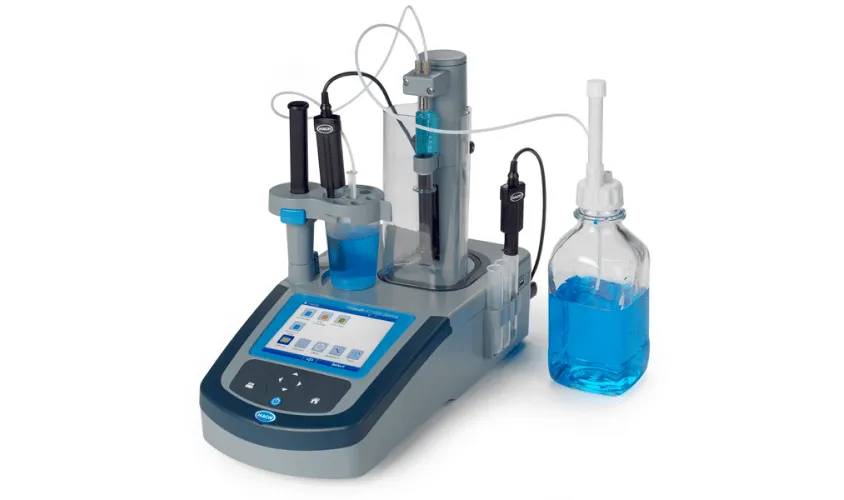
A cooling tower program is confirmed by testing, not assumed from the dosing pump's activity. Routine testing of pH, conductivity/TDS, and biocide or inhibitor residual, along with periodic microbiological testing, is what verifies the program is holding the intended chemistry and controlling biological load, rather than simply running on schedule.
Maintenance Best Practices
- Test cooling tower water chemistry and microbiological activity on a fixed schedule appropriate to the system's size and criticality.
- Keep blowdown rate matched to actual cycles of concentration targets, verified by conductivity testing.
- Inspect fill media, basin, and distribution systems periodically for scale, sediment, or biological growth.
- Rotate or combine biocide types rather than relying on a single chemistry indefinitely.
- Review the full chemical program whenever makeup water source, system load, or ambient conditions change materially.
Industrial Applications
Cooling tower treatment requirements vary by industry and use case. Textile and garment finishing plants often run cooling towers supporting dyeing and process chillers where consistent temperature control affects product quality directly. Food and beverage facilities require treatment chemistries compatible with any indirect food-contact considerations in their specific process. Pharmaceutical facilities typically operate under tighter microbiological control requirements. Power plants and large industrial sites often run at a scale where even small efficiency losses from scale or fouling carry a significant cumulative energy cost. A program should always be designed around the specific facility and system, not applied generically.
Benefits
- Maintained heat transfer efficiency and cooling capacity over the system's service life.
- Lower energy consumption, since clean surfaces transfer heat more efficiently than scaled or fouled ones.
- Reduced water and chemical consumption through safely optimized cycles of concentration.
- Lower biological and public health risk through controlled microbial activity.
- Fewer unplanned shutdowns for cleaning or component replacement.
Conclusion
A cooling tower's open, evaporative design is what makes it efficient, and also what makes it vulnerable to scale, corrosion, and biological fouling in ways a closed system never experiences. Understanding cycles of concentration, and how scale inhibitors, corrosion inhibitors, biocides, and biodispersants each address a distinct part of the problem, gives facility engineers the working knowledge to evaluate whether their current program is actually protecting the system.
Call to Action
Carbolabs Corporation's technical team works directly with facilities across Bangladesh to assess cooling tower water quality and design a treatment program matched to your specific system and operating conditions. Talk to our engineers about your cooling tower water treatment program.