Of all the risks a cooling tower can present, Legionella is the one with the most serious consequences and the least room for a "we'll get to it eventually" approach. Unlike scale or corrosion, which develop as gradual efficiency losses, Legionella risk is a public health matter with real regulatory and reputational stakes attached. This guide covers what Legionella is, why cooling towers are a recognized risk factor, and the practical risk management program that keeps that risk under control.
What Is Legionella
Legionella is a type of bacteria naturally present in many water environments, capable of causing Legionnaires' disease (a serious form of pneumonia) when contaminated water is aerosolized and inhaled in sufficient concentration. It is not unique to cooling towers; Legionella can colonize any building water system with the right conditions. Cooling towers are specifically flagged as a risk factor because they are designed to aerosolize water as part of their normal operation, creating a direct pathway from contaminated water to airborne exposure.
This is worth stating plainly for anyone new to the topic: the concern is not that cooling towers are inherently dangerous, or that Legionella exposure is common. The concern is that an unmanaged or poorly managed cooling tower creates the specific combination of conditions (warm stagnant water, organic nutrients, and aerosolization) that this particular organism needs, and a well-managed one systematically removes those conditions. The difference between a well-run and poorly-run tower, from a Legionella standpoint, is entirely a function of the treatment and maintenance program, not the equipment itself.
Why Cooling Towers Are a Risk Factor
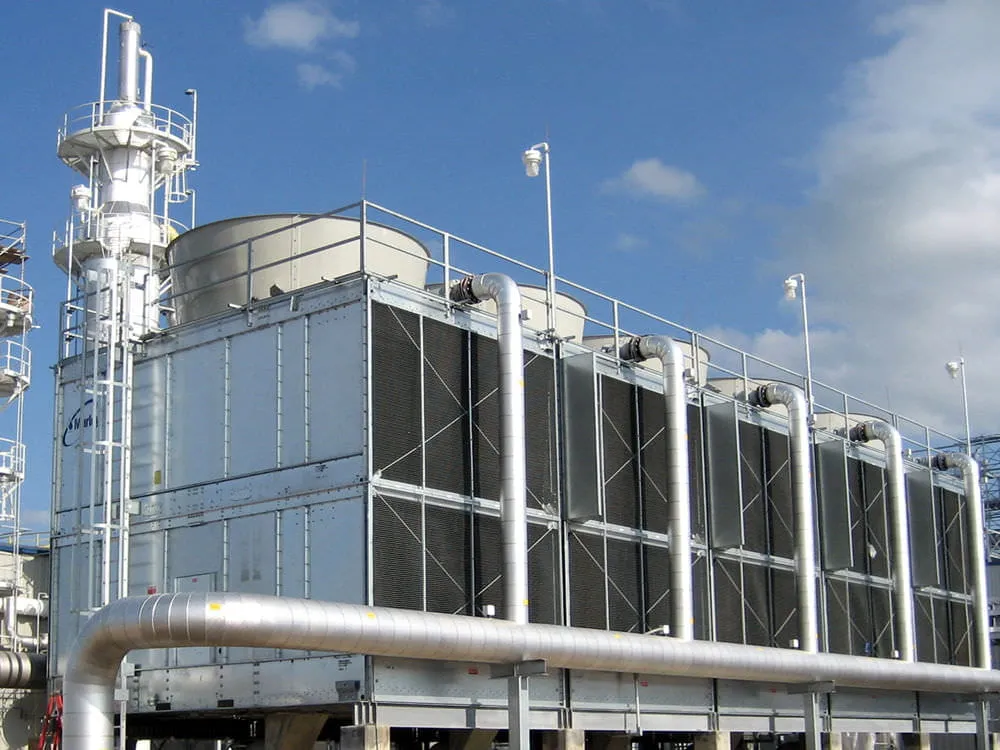
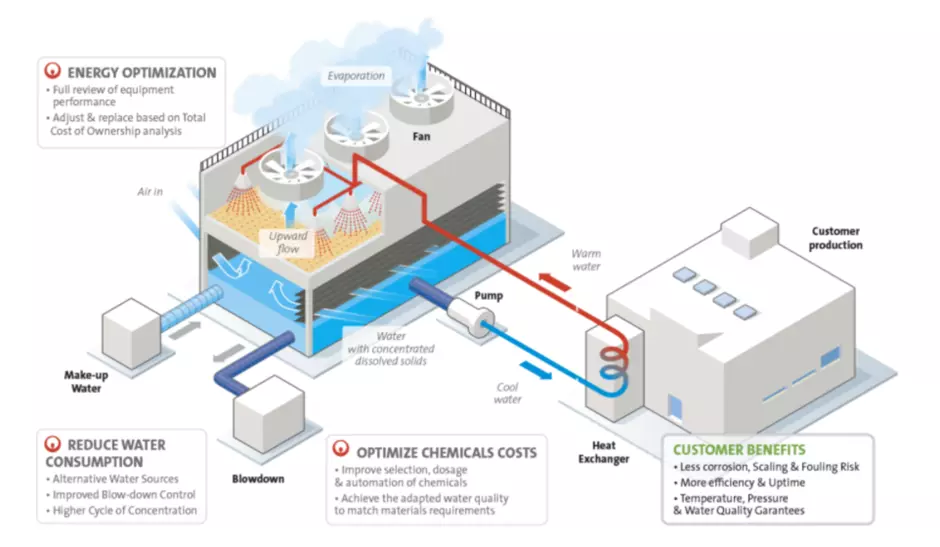
A cooling tower's entire cooling mechanism depends on maximizing water-to-air contact: spraying or cascading water through fill media while air is drawn through it. This same mechanism that makes heat rejection efficient also means that any Legionella present in the circulating water has a direct route to become airborne in the tower's drift, potentially traveling beyond the immediate vicinity of the tower itself. This combination of warm water, aerosolization, and public accessibility is what makes cooling towers a recurring subject of Legionella risk guidance internationally.
How Legionella Spreads
Legionella exposure occurs through inhalation of contaminated water droplets small enough to reach the lower respiratory tract, not through drinking contaminated water or person-to-person contact. Cooling tower drift (the fine droplets carried out of the tower in the exhaust airstream) is the specific exposure pathway of concern, which is precisely why drift eliminator performance is as much a Legionella control measure as it is a water conservation one.
Distance and wind conditions affect how far drift can travel before dispersing to a concentration low enough to no longer pose a meaningful exposure risk, which is part of why cooling tower placement, orientation, and proximity to building air intakes or pedestrian areas are also considered during a thorough risk assessment, not purely a water treatment question, but a facility design and siting one as well.
Conditions That Favor Growth
Legionella grows most readily in warm water within a specific temperature range broadly overlapping typical cooling tower operating temperatures, particularly in areas of low or stagnant flow where biofilm can establish. Nutrient availability (from airborne organic debris, scale, corrosion products, or other microorganisms) further supports growth, meaning a cooling tower with poor general water treatment is very often creating exactly the conditions Legionella needs, even if Legionella itself was never the primary concern driving that treatment program.
Biofilm's Role in Legionella Risk
Biofilm is not just a heat transfer and fouling problem: it is a documented protective habitat for Legionella, sheltering the bacteria from biocide exposure and providing a stable environment for it to persist and multiply. This is a critical point often underappreciated in Legionella risk discussions: a biocide program that never adequately controls biofilm is not fully controlling Legionella risk either, regardless of how well it performs against free-floating bacteria in bulk water testing.
This explains a pattern that sometimes puzzles facility teams: bulk water testing shows acceptable bacterial counts, yet Legionella is still detected during a targeted test. The gap is almost always biofilm: a thin, well-established layer in low-flow areas can host a persistent Legionella population while contributing very little to the overall bacterial count measured in a general bulk water sample. This is precisely why biodispersant use, and its role in exposing biofilm to biocide penetration, is treated as a core part of Legionella control rather than an optional add-on to a general fouling control program.
Risk Assessment Basics
A Legionella risk assessment identifies where water can stagnate, where temperatures fall into the range that favors growth, and where aerosolization can occur. Cooling towers, along with other building water systems such as domestic hot water and decorative fountains, are typically included in a comprehensive assessment. Internationally recognized frameworks such as ASHRAE Standard 188 and the UK Health and Safety Executive's HSE L8 approach to Legionella control are commonly referenced starting points for structuring a risk assessment, though facilities in Bangladesh should confirm which specific local regulatory or public health guidance applies to their situation rather than relying on any single international framework as a substitute for local compliance requirements.
A practical risk assessment typically walks the entire water system, not just the cooling tower itself, and asks the same basic questions at each point: can water stagnate here, does temperature fall into a range that favors growth, and can this location generate an aerosol. A cooling tower usually scores as higher-risk on all three questions simultaneously, which is exactly why it tends to receive the most attention in a facility-wide assessment, but it should never be assessed in isolation from the rest of the building's water systems.
Monitoring and Testing
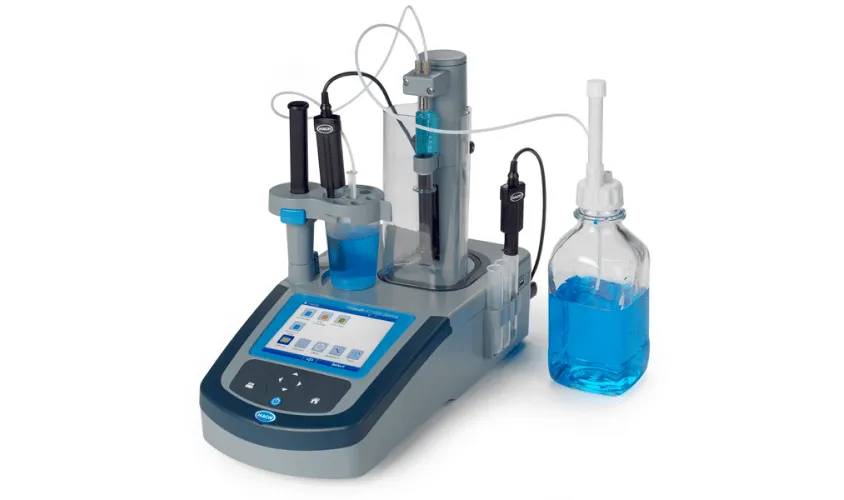
Legionella risk monitoring typically combines routine water chemistry testing (pH, conductivity, biocide residual) with periodic microbiological testing specifically for Legionella, since general bacterial counts do not reliably indicate Legionella presence or absence on their own. Testing frequency and methodology should be set in consultation with a qualified water treatment provider or public health authority, since testing protocols and acceptable response thresholds are specialized areas beyond general water treatment practice.
Water Treatment Program's Role
A well-run scale, corrosion, and biofouling control program is the foundation of Legionella risk management, not a separate initiative: oxidizing and non-oxidizing biocides reduce the bacterial population directly, biodispersants break down the biofilm that shelters Legionella from biocide exposure, and scale/corrosion control removes the surface irregularities and deposits that biofilm colonizes most readily. Facilities that already run a disciplined water treatment program, as described elsewhere in this resource center, have already built most of the foundation Legionella risk management depends on.
Mechanical Controls
Beyond chemical treatment, mechanical design and maintenance factors meaningfully affect Legionella risk: well-maintained drift eliminators limit aerosol escape, basin design that avoids low-flow dead zones reduces stagnation, and accessible design that allows thorough physical cleaning during shutdowns all contribute to overall risk reduction. A cooling tower that is chemically well-treated but mechanically neglected (a damaged drift eliminator, an unreachable basin corner) can still carry meaningful risk that chemistry alone does not fully address.
Documentation and Compliance
Maintaining clear, dated records of water testing, chemical dosing, biocide rotation, mechanical inspections, and any corrective actions taken is not just good practice: it is typically a specific expectation under most Legionella risk management frameworks, since demonstrating a consistently managed program is often as important as the underlying water chemistry itself when risk is reviewed or investigated. A facility with a genuinely good treatment program but no documentation trail is in a materially weaker position than one with equivalent treatment and clear records.
In practice, this means keeping records that would allow someone unfamiliar with the day-to-day operation to reconstruct exactly what was tested, when, what the results were, what dosing was in effect, and what corrective action followed any out-of-range result. A logbook that only records "chemicals topped up" without dates, quantities, or test values attached provides little value if the program's effectiveness is ever questioned, whereas a structured log with consistent fields makes it straightforward to demonstrate a well-managed program going back months or years.
Emergency Response
If Legionella is detected above an actionable threshold, or if a suspected or confirmed case of Legionnaires' disease is linked to a facility, immediate consultation with a qualified water treatment specialist and the applicable public health authority is essential: this is not a situation to manage through general water treatment adjustments alone. Facilities should have a documented emergency response plan established in advance, rather than developing one for the first time under the pressure of an actual detection event.
A prepared plan generally identifies in advance who has authority to order a shutdown or shock treatment, which specialist or laboratory will be contacted for confirmatory testing, and how internal and any required external notifications will be handled, decisions that are far better made calmly ahead of time than improvised during an actual event, when time pressure and incomplete information make good judgment considerably harder.
Common Mistakes
- Treating Legionella risk as a separate program disconnected from routine scale, corrosion, and biofouling control.
- Assuming general bacterial testing is an adequate substitute for specific Legionella testing.
- Neglecting mechanical factors (drift eliminator condition, basin dead zones) that pure chemistry cannot fully offset.
- Inconsistent or missing documentation of testing, dosing, and inspection records.
- Having no emergency response plan prepared before it is actually needed.
Maintenance Checklist
- Maintain the scale, corrosion, and biofouling control program as the foundation of Legionella risk management.
- Perform periodic Legionella-specific testing, not only general microbiological or chemical testing.
- Inspect and maintain drift eliminators to limit aerosol escape.
- Design and maintain basin cleaning routines that reach low-flow and hard-to-access areas.
- Keep dated, complete records of testing, dosing, biocide rotation, and inspections.
- Establish and periodically review a documented emergency response plan.
Conclusion
Legionella risk management in cooling towers is not a separate discipline from good water treatment: it is what a disciplined scale, corrosion, and biofouling program becomes when combined with specific Legionella testing, mechanical maintenance, and documentation. Facilities that already run a well-managed treatment program are closer to effective Legionella risk management than they may realize; the remaining work is making the connection explicit, testing specifically for it, and documenting the result.
Call to Action
Carbolabs Corporation's technical team can review your current cooling tower treatment program against Legionella risk management best practices and help you close any gaps. Contact our engineers for a technical assessment.