Every cooling tower runs on a simple water balance: what comes in as makeup water must equal what leaves through evaporation, drift, and blowdown. Understanding this balance, and the cycles of concentration it produces, is the single most useful piece of operating knowledge for controlling water and chemical costs without compromising scale, corrosion, or biological protection. This guide breaks down each part of the water balance, how to calculate and optimize cycles of concentration, and the practical limits that determine how far you can safely push it.
Understanding Water Balance
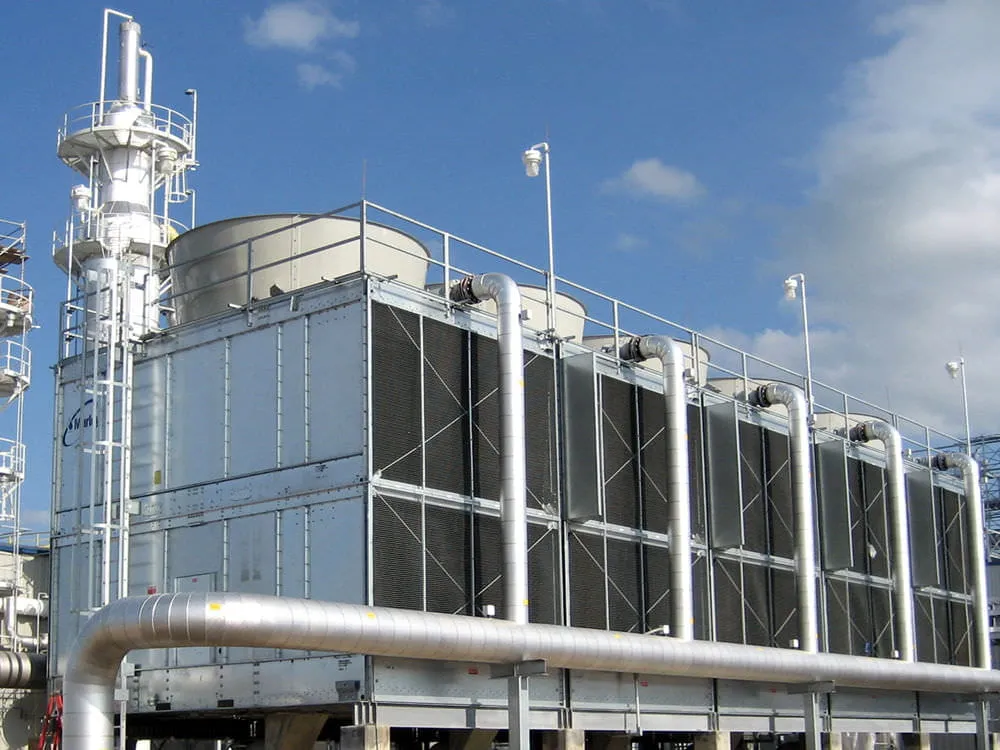
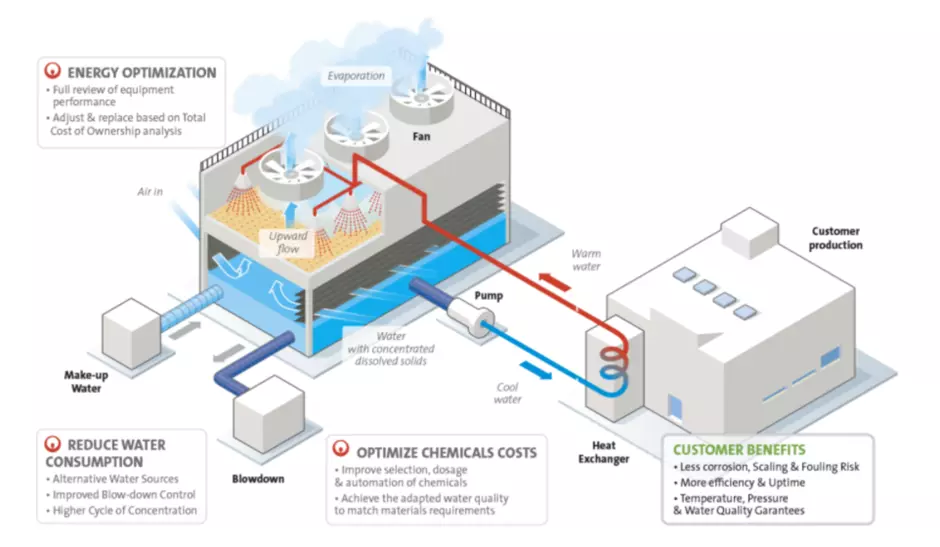
A cooling tower's water balance describes where makeup water goes: a portion evaporates to reject heat (the tower's entire purpose), a small portion is lost as drift (fine droplets carried out with the exhaust air), and the remainder must be deliberately discharged as blowdown to keep dissolved solids from concentrating indefinitely. Makeup water flow is simply the sum of these three losses, meaning any change to one of them changes how much makeup water the system actually needs.
Evaporation Loss
Evaporation is the mechanism that makes a cooling tower work: as water evaporates, it carries heat away, cooling the remaining water. Evaporation rate scales with heat load and is largely outside an operator's control on a day-to-day basis: it is a function of how much heat the process is rejecting, not a setting to be optimized. What is controllable is everything downstream of evaporation: how the concentrated minerals left behind are managed.
Drift Loss
Drift is water carried out of the tower as fine liquid droplets entrained in the exhaust airstream, distinct from evaporation because it carries the full mineral and chemical concentration of the circulating water, not just pure water vapor. Modern drift eliminators reduce this loss to a small fraction of circulating flow, and a properly maintained eliminator is also a meaningful factor in limiting how far chemically treated water and any biological content can travel beyond the tower itself.
Blowdown Loss
Blowdown is the only loss in the water balance that is fully within operator control, and it is the primary lever for managing cycles of concentration. Unlike evaporation and drift, which are largely fixed by tower design and heat load, blowdown rate can be adjusted directly: increasing it lowers cycles of concentration (using more makeup water and chemical but reducing scale/corrosion risk), while decreasing it raises cycles (saving water but concentrating dissolved solids further).
Makeup Water Requirement
Total makeup water demand equals evaporation plus drift plus blowdown. Because evaporation is fixed by heat load, and drift is fixed by the eliminator's design efficiency, blowdown is the only variable that can be tuned, meaning every water conservation conversation about a cooling tower is, in practice, a conversation about blowdown rate and cycles of concentration.
This is a useful mental model for anyone evaluating a facility's water efficiency: if evaporation and drift are already fixed by the tower's design and current heat load, the only remaining question worth asking is "what cycles of concentration is this blowdown rate actually achieving, and is it the safe maximum for this water source?" Every other water-saving idea for a cooling tower ultimately routes back through that same question.
Cycles of Concentration Explained
Cycles of concentration (COC) is the ratio between the concentration of dissolved solids in the circulating water and the concentration in the makeup water feeding it. A system operating at 5 cycles has circulating water with dissolved solids five times more concentrated than its makeup water, and by extension, every mineral, and every treatment chemical dosed proportionally to makeup flow, is five times more concentrated in the tower than in the water entering it.
Calculating Cycles of Concentration
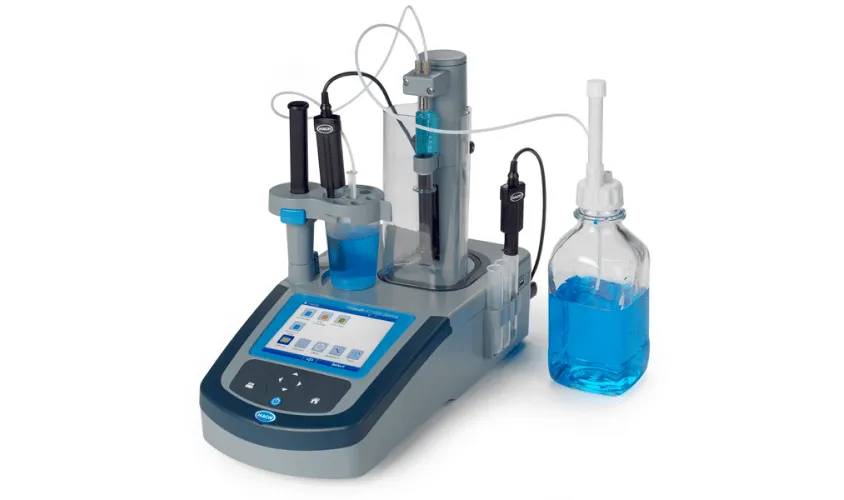
Cycles of concentration can be estimated by comparing a stable water quality parameter (conductivity, chloride, or another indicator not consumed or produced by biological or chemical activity) between makeup water and circulating water. Dividing the circulating water reading by the makeup water reading gives an approximate COC. Conductivity is the parameter most commonly used in daily operation because it can be measured instantly, while chloride or other more stable tracer ions are sometimes used for a more precise periodic check, since conductivity can be influenced by treatment chemicals themselves.
Why Higher Cycles Save Water and Money
Operating at higher cycles of concentration directly reduces blowdown volume for the same evaporation rate, which reduces both makeup water consumption and the chemical needed to treat that makeup water. The relationship is not linear: the water savings gained by increasing cycles diminish at higher cycle counts, meaning the jump from 2 to 4 cycles saves considerably more water proportionally than the jump from 8 to 10 cycles, even though both represent a doubling in the ratio.
This diminishing-returns pattern is worth understanding before investing in equipment or chemistry specifically to push cycles higher. A facility currently running at very low cycles (2 or 3) often has meaningful, low-cost water savings available simply by correcting an oversized or poorly calibrated blowdown valve. A facility already running at 6 or 8 cycles is much closer to the point where further increases require disproportionate investment in pretreatment or specialty inhibitor chemistry for comparatively smaller water savings.
The Limiting Factors
Cycles of concentration cannot be increased indefinitely: at some point, a specific dissolved constituent in the makeup water reaches its solubility or corrosion-risk limit and begins causing scale, corrosion, or other damage. Identifying which constituent is the actual limiting factor for a given makeup water source is what determines the safe maximum COC for that specific system, and it is rarely the same constituent from one facility to the next.
Silica and Hardness Limits
Calcium hardness and silica are the two dissolved constituents that most commonly set the practical ceiling on cycles of concentration, since both form hard, difficult-to-remove scale once their solubility limit is exceeded. A makeup water source high in silica but relatively low in hardness will hit its silica-driven ceiling before hardness becomes a concern, while the reverse is true for a hardness-dominant water source, which is exactly why a water analysis of the specific makeup water source, not a generic assumption, should drive the maximum cycles target.
It is also worth noting that the limiting constituent is not always mineral scale at all: for makeup water with elevated chloride content, corrosion risk to certain metallurgies can become the practical ceiling before scale ever would, particularly for systems with stainless steel or specific alloy components sensitive to chloride stress corrosion. This is one more reason a full water analysis, rather than a hardness test alone, is the appropriate basis for setting a cycles of concentration target.
Conductivity as a Proxy
Because directly measuring every dissolved constituent continuously is impractical, conductivity is used as a fast, real-time proxy for overall dissolved solids concentration, and blowdown control is typically automated around a conductivity setpoint corresponding to the safe maximum cycles determined for that system. The conductivity-to-COC relationship should be periodically re-verified against actual laboratory water analysis, since it can drift if makeup water quality itself changes over time.
Blowdown Control Methods
Manual blowdown relies on an operator periodically checking conductivity and adjusting a valve, which works for smaller systems with attentive staff but is vulnerable to the same gaps in routine that affect any manually-triggered task. Automated blowdown control uses a continuous conductivity sensor to modulate a control valve in real time, holding cycles closer to the target with less dependence on manual timing, though the sensor itself still needs periodic calibration verification to remain trustworthy.
For facilities weighing the investment, automated control tends to pay for itself fastest on larger systems or those with significant seasonal load swings, where the water and chemical savings from consistently accurate cycles control compound meaningfully over a full year of operation. Smaller, more stable systems may find a well-disciplined manual routine (checked and logged every shift) delivers similar real-world results at a fraction of the equipment cost.
Seasonal Adjustments
Ambient temperature and humidity directly affect evaporation rate for a given heat load, which changes how quickly dissolved solids concentrate and, in turn, how much blowdown is needed to hold the same cycles target. A blowdown setpoint verified correct during one season can leave the system running at different actual cycles once conditions shift, making periodic re-verification a genuine operational necessity rather than a formality.
Water Balance Auditing
A water balance audit compares actual makeup water consumption against the theoretical requirement calculated from heat load, drift rate, and blowdown rate. A significant, unexplained gap between actual and theoretical makeup water usage usually points to an undocumented loss (a leak, basin overflow, or a blowdown valve stuck open), worth investigating directly rather than assumed to be normal variation.
Running this audit even once a year, rather than only when a water bill spikes unexpectedly, tends to catch small discrepancies before they compound into a large, hard-to-diagnose gap. A basin overflow leaking at a rate too small to notice visually can still represent a meaningful, continuous water loss that a periodic audit (comparing metered makeup water against the calculated theoretical requirement) will reveal far sooner than casual observation ever would.
Common Mistakes
- Setting a blowdown rate once and never revisiting it as makeup water quality, season, or system load changes.
- Assuming a generic cycles of concentration target applies to every makeup water source without checking the actual limiting constituent.
- Relying on conductivity readings without periodically verifying the sensor's calibration against a handheld meter.
- Treating water balance auditing as unnecessary when blowdown appears to be running normally.
- Increasing cycles of concentration purely for water savings without confirming the scale inhibitor program can handle the resulting concentration.
Maintenance Checklist
- Test makeup and circulating water conductivity on a fixed schedule to verify actual cycles of concentration.
- Confirm blowdown rate against the safe maximum cycles determined for the current makeup water source.
- Calibrate automated conductivity sensors against a handheld meter on a regular schedule.
- Re-verify blowdown settings seasonally as evaporation rate shifts with ambient conditions.
- Perform a water balance audit periodically, comparing actual makeup consumption against theoretical requirement.
- Inspect drift eliminators for damage or degradation that would increase drift loss beyond design.
Conclusion
Water balance and cycles of concentration are not abstract engineering concepts: they are the direct, calculable link between how a cooling tower is operated and how much water, chemical, and money it consumes. Understanding evaporation, drift, and blowdown as the three components of makeup water demand, and knowing which dissolved constituent actually limits your specific system's safe cycles of concentration, turns blowdown from a fixed setting into a genuine optimization opportunity.
Call to Action
Carbolabs Corporation's technical team can analyze your makeup water quality, calculate your system's actual safe cycles of concentration, and help you optimize blowdown for real water and chemical savings. Talk to our engineers about your cooling tower water balance.