Every industrial boiler runs on two things: fuel and water. Operators spend a great deal of time optimizing combustion efficiency, yet the water side of the equation is just as critical, and far more likely to be overlooked until something fails. Untreated or poorly treated boiler water quietly deposits scale on heat transfer surfaces, corrodes metal from the inside out, and eventually forces an unplanned shutdown that costs far more than a treatment program ever would.
This guide walks through what boiler water treatment actually does, why it matters for textile mills, garment factories, food and beverage plants, pharmaceutical facilities, and power generation units across Bangladesh, and how the major chemical categories work together to keep a boiler running safely and efficiently for its full service life.
What Is Boiler Water Treatment
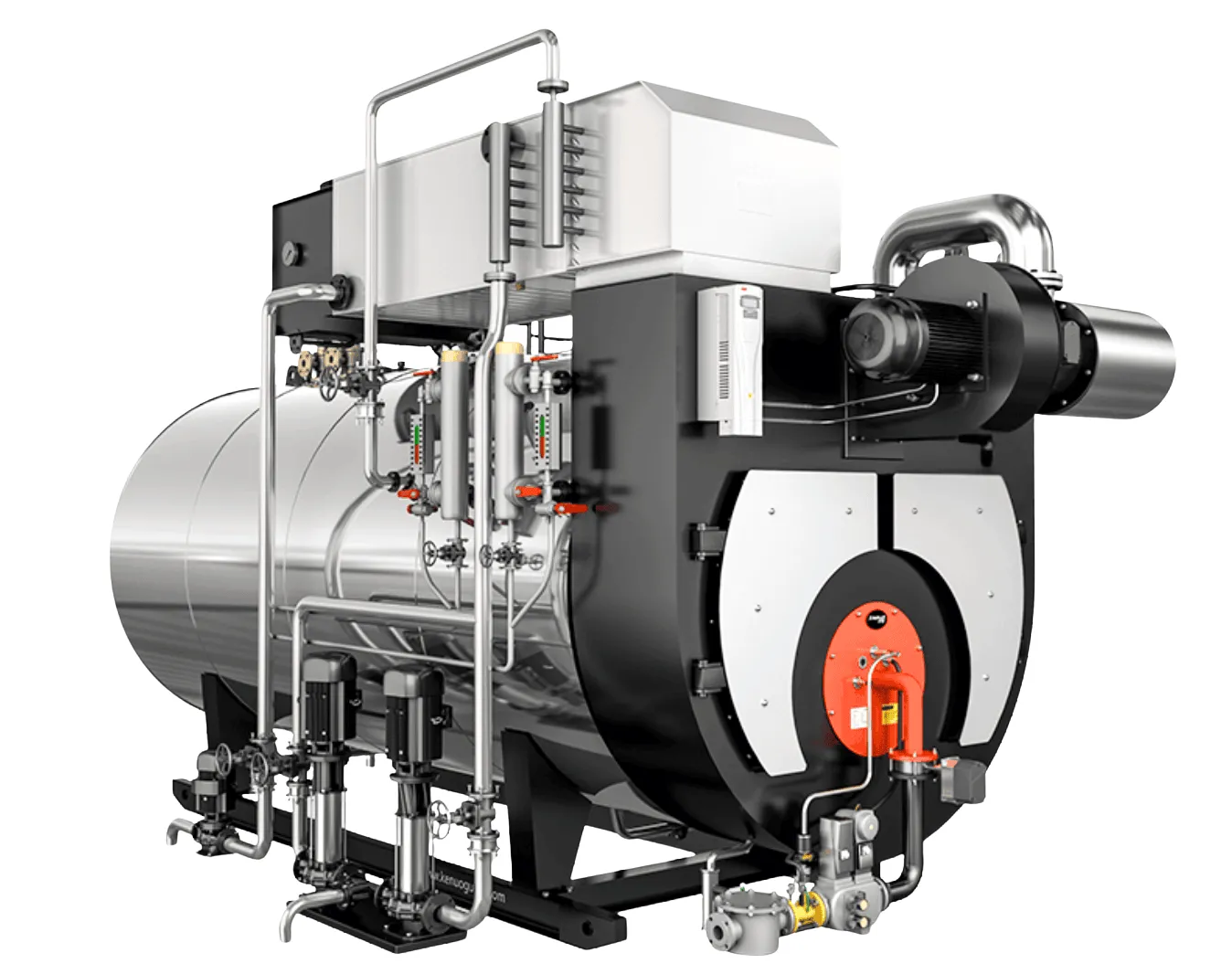
Boiler water treatment is the combination of external pretreatment (softening, filtration, reverse osmosis) and internal chemical treatment (dosing the boiler and condensate system with conditioning chemicals) used to control the impurities naturally present in feedwater. Raw water, whether from a municipal supply, a tube well, or a river source, carries dissolved minerals, dissolved gases, and suspended solids that are largely harmless in a glass of drinking water but become aggressive once concentrated and heated inside a pressurized steam-generating vessel.
A treatment program is not a single product. It is a system: correctly softened or demineralized makeup water, a chemical dosing regime matched to the boiler's operating pressure and feedwater quality, a blowdown schedule that keeps dissolved solids within a safe range, and a testing routine that confirms the program is actually working.
Why Water Treatment Is Important
A boiler that runs on untreated or under-treated water does not usually fail suddenly. It degrades gradually, which is precisely what makes the problem dangerous. Efficiency drops a fraction of a percent at a time as scale builds on tubes. Corrosion thins metal walls over months or years. By the time symptoms are obvious, such as rising fuel bills, popping or rumbling noises, and frequent tube leaks, the underlying damage is often already extensive and expensive to reverse.
Industry data cited across boiler engineering literature consistently shows that even a thin layer of scale meaningfully increases fuel consumption because scale deposits insulate the heat transfer surface, forcing the burner to work harder to transfer the same amount of heat into the water. Combined with the capital cost of tube replacement and the production losses from an unplanned outage, water treatment is one of the highest-return investments available to a boiler operator.
Scale Formation
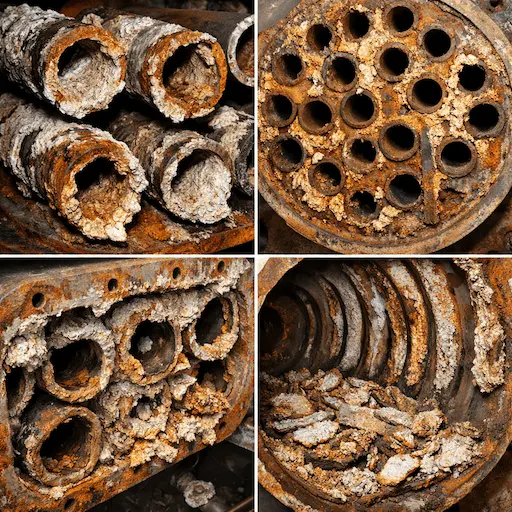
Scale is the hard, adherent mineral deposit that forms when hardness salts, mainly calcium and magnesium compounds, exceed their solubility limit as boiler water is heated and concentrated by evaporation. Unlike sludge, scale bonds tightly to metal surfaces and cannot be removed by blowdown alone; it typically requires mechanical or chemical descaling once it has formed.
Because scale is such a poor conductor of heat compared to steel, it forces tube metal temperatures to rise in the areas where it builds up. In severe cases this localized overheating leads directly to tube failure, which is why scale prevention through proper softening and scale-inhibitor dosing is treated as a first-line priority rather than a secondary concern.
Boiler Corrosion
Corrosion in a boiler system is an electrochemical process that thins and eventually perforates metal surfaces. It is typically driven by dissolved oxygen, low or fluctuating pH, and dissolved carbon dioxide that forms carbonic acid in the condensate system. Unlike scale, corrosion damage is often hidden until a tube fails, since it can proceed on the inside surface of piping and tubes where it cannot be visually inspected during normal operation.
Effective corrosion control combines mechanical deaeration, oxygen-scavenging chemicals, and pH control within the boiler and condensate systems, supported by regular water testing to confirm the program is holding the intended chemistry.
Oxygen Attack
Oxygen attack is a specific and particularly aggressive form of corrosion caused by dissolved oxygen in feedwater. Because oxygen pitting is localized rather than uniform, it can perforate a tube wall while the surrounding metal looks largely intact, making it one of the more dangerous corrosion mechanisms a boiler operator will encounter. Mechanical deaeration reduces dissolved oxygen to low levels, and chemical oxygen scavengers are dosed to react with the residual oxygen that mechanical deaeration cannot fully remove.
Sludge Formation
Sludge is the soft, loose precipitate formed when hardness salts are chemically precipitated in the boiler water rather than allowed to bond onto hot metal surfaces as scale. A well-designed internal treatment program deliberately encourages precipitation into sludge, using polymer dispersants to keep the particles suspended and non-adherent, because sludge can be removed safely through routine bottom blowdown, unlike scale.
Carryover
Carryover occurs when boiler water, in the form of droplets, dissolved solids, or foam, is entrained in the steam leaving the drum instead of remaining behind. It contaminates steam quality, deposits solids on superheater tubes and turbine blades, and can cause water hammer in steam distribution piping. Carryover is generally linked to high total dissolved solids concentration, excessive alkalinity, contamination by oil or organic matter, or operating the boiler above its rated steaming capacity, and is controlled through correct blowdown rates and anti-foam or steam-quality treatment chemicals.
Boiler Water Quality Parameters
Boiler water chemistry is monitored against a set of core parameters rather than any single number. The table below summarizes the parameters most commonly tracked in industrial fire-tube and water-tube boiler operation; exact target ranges vary by boiler pressure, design, and manufacturer guidance, so treat the ranges below as general orientation rather than a fixed specification for any specific boiler.
| Parameter | What It Indicates | General Guidance |
|---|---|---|
| pH | Acidity/alkalinity balance | Slightly alkaline, per boiler manufacturer and OEM guidance |
| Total Dissolved Solids (TDS) | Concentration of dissolved minerals | Controlled via blowdown to the OEM-specified limit for the operating pressure |
| Total Hardness | Calcium and magnesium content | As close to zero as the pretreatment system allows |
| Dissolved Oxygen | Corrosion potential | Minimized via deaeration and oxygen scavenger dosing |
| Alkalinity | Buffering capacity, carryover risk | Maintained within program-specific limits, not excessive |
| Silica | Turbine deposit risk (for steam-driven turbines) | Controlled relative to operating pressure |
These figures should always be read alongside the boiler manufacturer's own operating manual and the recommendations of a qualified water treatment provider, since acceptable ranges shift meaningfully with operating pressure and boiler design.
Types of Boiler Chemicals
A complete internal treatment program is built from several distinct chemical categories, each addressing a different failure mechanism. Using only one category, for example, an oxygen scavenger without a scale inhibitor, leaves the system exposed to the mechanisms that chemical does not address.
Oxygen Scavengers
Oxygen scavengers are dosed into feedwater to chemically react with residual dissolved oxygen that mechanical deaeration does not remove, converting it into a form that no longer attacks metal surfaces. Common scavenger chemistries include sulfite-based and organic (amine-based) products, selected according to boiler pressure, feedwater quality, and whether the condensate is reused for food-contact or other sensitive applications.
Scale Inhibitors
Scale inhibitors work by interfering with the crystal growth of hardness salts, keeping calcium and magnesium compounds from bonding onto hot tube surfaces even when hardness is present in the feedwater. They are typically dosed continuously in proportion to feedwater hardness and boiler load.
Polymer Dispersants
Polymer dispersants keep precipitated solids, such as sludge, iron oxide particles, and scale-forming compounds, suspended in the bulk boiler water rather than allowed to settle and bond onto surfaces. This keeps the boiler water "clean" in a practical sense: solids remain mobile enough to be removed through routine blowdown.
Alkalinity Builders
Alkalinity builders adjust and buffer boiler water pH into the range recommended for the specific boiler design and pressure, protecting metal surfaces from both acidic corrosion at low pH and caustic attack at excessively high pH.
Condensate Treatment
Condensate, the water recovered after steam gives up its heat, is normally the purest water in the entire steam system, which is exactly why returning it to the boiler is so valuable for both water and fuel economy. But condensate piping is also vulnerable to carbonic acid corrosion, caused by carbon dioxide released when bicarbonate alkalinity breaks down under boiler heat. Neutralizing amines and filming amines are used specifically to protect the condensate return system, separate from the chemicals dosed into the boiler itself.
Chemical Dosing
Dosing accuracy directly determines whether a treatment program succeeds. Underdosing leaves the boiler exposed to scale and corrosion; overdosing wastes chemical, can push alkalinity or TDS outside safe limits, and increases blowdown losses. Most industrial boilers use either continuous metering pumps calibrated to feedwater flow, or a shot/batch dosing routine tied to a fixed schedule and confirmed by water testing, a topic covered in full detail in our companion Boiler Chemical Dosing Guide.
Water Testing
A treatment program is only as good as the testing that verifies it. Daily or per-shift testing of boiler water pH, TDS/conductivity, and sulfite or oxygen scavenger residual, alongside periodic laboratory testing for hardness, alkalinity, and silica, is what confirms that dosing rates are correct and that the program is actually protecting the boiler, rather than assuming it is working.
Maintenance Best Practices
- Test boiler water chemistry at a fixed frequency appropriate to boiler pressure and criticality, and log results consistently.
- Keep bottom and surface blowdown on a documented schedule rather than an ad-hoc basis.
- Inspect condensate return quality regularly, since it is often the first place contamination or corrosion symptoms appear.
- Review chemical dosing rates whenever feedwater source, boiler load, or production schedule changes.
- Schedule an internal tube inspection during planned annual shutdowns to catch scale or corrosion before it becomes a failure.
Industrial Applications
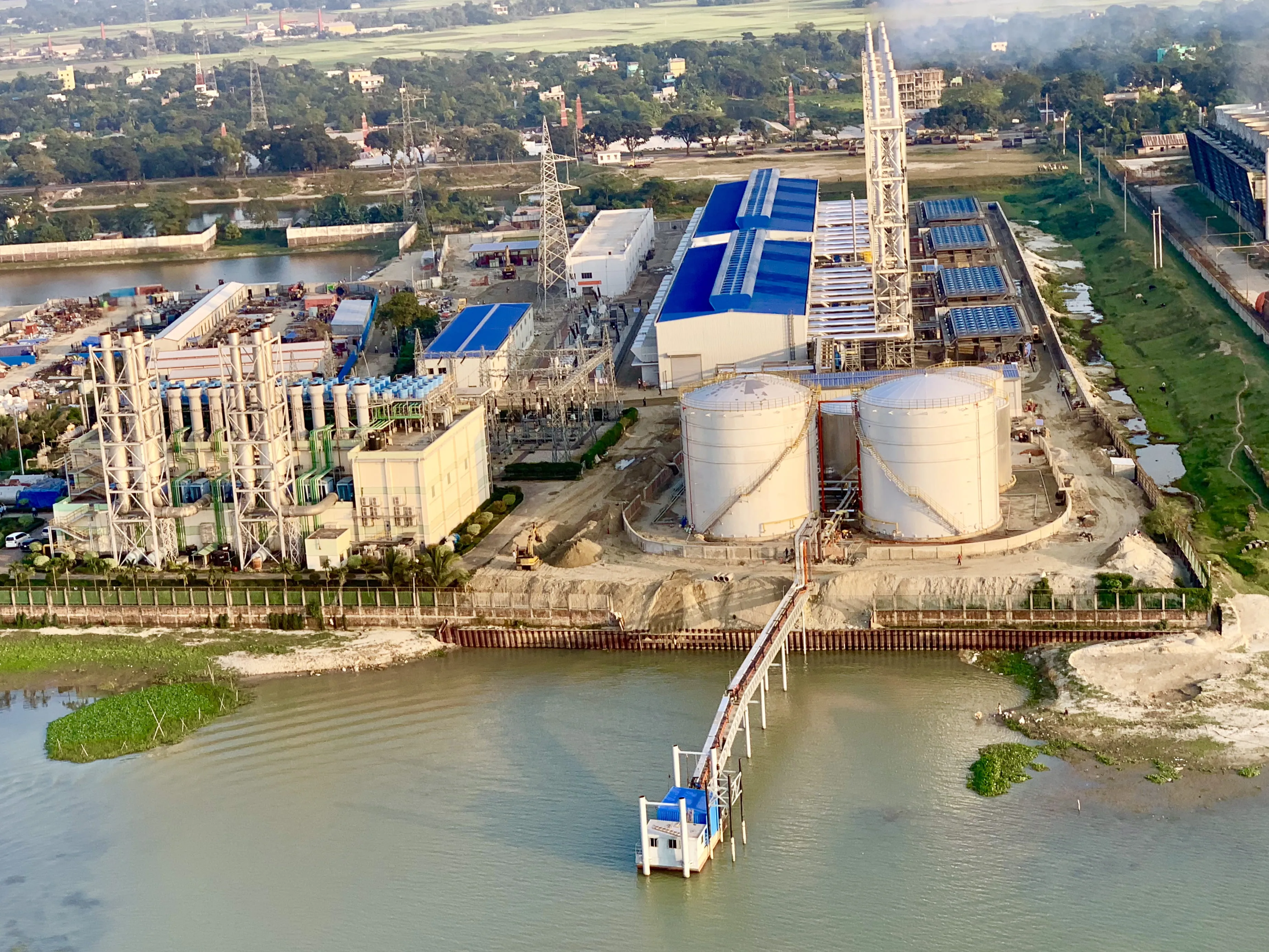
Boiler water treatment requirements differ meaningfully by industry. Textile and garment factories often run high-demand, variable-load boilers feeding dyeing and finishing processes where steam quality affects fabric quality directly. Food and beverage plants require treatment chemistries compatible with food-contact steam applications. Pharmaceutical facilities typically run tighter water quality tolerances tied to regulatory compliance. Power plants and large paper mills operate at higher pressures where even small deviations in water chemistry carry outsized risk. A treatment program should always be specified for the actual boiler, feedwater, and application, not applied generically across facility types.
Benefits
- Extended boiler and tube life by preventing scale buildup and corrosion damage.
- Lower fuel consumption, since clean heat transfer surfaces require less energy to raise steam.
- Fewer unplanned shutdowns and the production losses that come with them.
- More consistent steam quality for processes that depend on it.
- Lower long-term maintenance and capital replacement costs.
Conclusion
Boiler water treatment is not an optional add-on to boiler operation. It is a core part of running a boiler safely, efficiently, and economically over its intended service life. Understanding scale, corrosion, oxygen attack, sludge, and carryover, and how oxygen scavengers, scale inhibitors, dispersants, and alkalinity builders address each of them, gives operators and engineers the working knowledge needed to evaluate whether their current program is actually protecting their equipment.
Call to Action
Carbolabs Corporation's technical team works directly with boiler operators across Bangladesh to assess feedwater quality, design a chemical treatment program matched to your specific boiler and operating conditions, and support you with ongoing water testing guidance. Talk to our engineers about your boiler water treatment program.