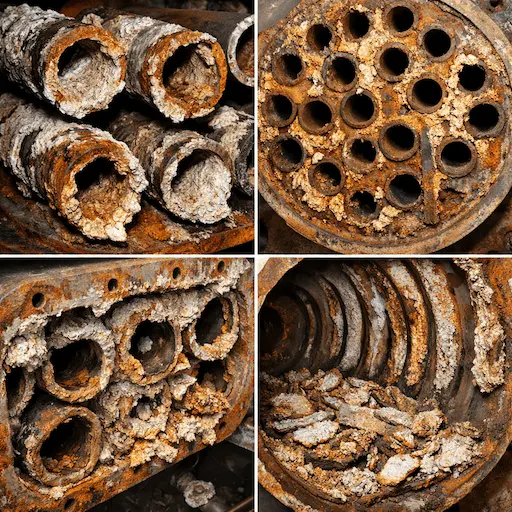
Scale and corrosion are the two failure mechanisms responsible for the overwhelming majority of premature boiler tube damage. They work differently (scale insulates, corrosion thins), but both start from the same root cause: water chemistry that has not been properly conditioned before it enters the boiler. This guide focuses specifically on how each mechanism develops and the concrete steps that prevent them, building on the broader overview in our Complete Guide to Boiler Water Treatment Chemicals.
Scale Formation
Scale forms when calcium and magnesium hardness salts exceed their solubility limit as boiler water is heated and concentrated through repeated evaporation cycles. Once that limit is crossed, the minerals precipitate directly onto the hottest available surface (almost always the tube wall closest to the flame or hot gas path), where they bond tightly rather than remaining suspended in the bulk water.
The danger of scale is proportional to its insulating effect. Steel is already a relatively efficient conductor of heat; scale is not. Even a thin, uniform layer forces the tube metal behind it to run hotter than design intent in order to push the same heat through into the water, and localized overheating is what ultimately causes bulging, cracking, or outright tube failure.
Types of Scale
| Scale Type | Primary Cause | Typical Characteristic |
|---|---|---|
| Calcium carbonate | Temporary (carbonate) hardness | Hard, often the first layer to form |
| Calcium sulfate | Permanent hardness at high concentration | Very hard, difficult to remove mechanically |
| Magnesium silicate | Silica combined with magnesium hardness | Extremely hard, poor heat conductor |
| Iron oxide deposits | Corrosion products carried from elsewhere in the system | Often porous, can trap other deposits underneath |
Recognizing which scale type is present matters because the correct scale inhibitor chemistry and mechanical descaling method both depend on the deposit's composition, a fact best confirmed through laboratory deposit analysis rather than visual inspection alone. A deposit that looks like ordinary calcium scale to the eye can in practice be a layered mix, with iron oxide from an upstream corrosion event trapped beneath a harder silicate layer; treating it as simple carbonate scale would leave the underlying corrosion problem unaddressed even after descaling.
In practical terms, this is why an experienced water treatment provider will ask for a deposit sample before recommending a chemical program rather than prescribing a generic scale inhibitor on the basis of a phone description. The cost of a short delay for analysis is small compared to running the wrong chemistry for months.
Causes of Corrosion
Boiler corrosion is fundamentally electrochemical: it requires an electrolyte (boiler water), a driving force (dissolved gases or pH imbalance), and a metal surface willing to give up electrons. The three drivers engineers watch most closely are dissolved oxygen, carbon dioxide, and pH excursions outside the boiler's design range, each explored below.
Oxygen Corrosion
Dissolved oxygen entering with feedwater is one of the most aggressive corrosion drivers in a boiler system. It attacks in a highly localized way, producing pits rather than uniform thinning, which is precisely why oxygen corrosion can perforate a tube while the surrounding metal still looks serviceable at a glance. Mechanical deaeration in the feedwater system removes the bulk of dissolved oxygen, and chemical oxygen scavengers handle the residual amount that mechanical deaeration cannot eliminate.
Carbon Dioxide Corrosion
Carbon dioxide does not typically enter as CO2 directly: it forms when bicarbonate and carbonate alkalinity in feedwater break down under boiler heat and pressure, releasing CO2 that travels with the steam into the condensate system. Once dissolved back into condensate, it forms carbonic acid, which is mildly acidic but persistently corrosive to condensate piping over time. This is why condensate lines, not just the boiler itself, need their own corrosion control strategy.
Pitting
Pitting is corrosion concentrated at a single point rather than spread evenly across a surface, and it is disproportionately dangerous because a tube can lose a large fraction of its wall thickness at one spot while the rest of the tube remains close to original thickness. Oxygen attack is the most common cause of pitting in boiler systems, though deposits that create localized differences in oxygen concentration under the deposit (a mechanism called under-deposit corrosion) can also initiate pits, which is one more reason scale and sludge control matter for corrosion prevention, not just efficiency.
A useful way to think about pitting risk is that it compounds: a small area of scale creates an oxygen-depleted pocket underneath it, that pocket becomes an anodic site relative to the surrounding metal, and the resulting pit deepens faster than uniform corrosion would in the same water chemistry. This is why boilers with a history of scale problems often show more severe pitting than boilers with clean tubes exposed to similar dissolved oxygen levels: the two mechanisms actively reinforce each other rather than acting independently.
Water Softening
Water softening (typically ion-exchange softening using a sodium or resin-based system) removes calcium and magnesium hardness from makeup water before it ever reaches the boiler. It is the single most effective mechanical step available for preventing scale, because it addresses the hardness at its source rather than trying to manage it chemically once it is already inside the boiler. A softener that has exhausted its resin capacity or is not regenerating correctly will silently pass hardness through, so regular hardness testing of softened water is essential rather than optional.
A common real-world failure pattern looks like this: a softener regenerates correctly for months, salt deliveries continue as scheduled, and nobody notices that the brine line has developed a partial blockage until a routine hardness test on softened water comes back positive. By that point, several weeks of low-level hardness may already have been entering the boiler, quietly building the first layer of scale. This is precisely why softened-water hardness testing should be treated as a required step in the maintenance checklist, not an occasional spot-check.
Reverse Osmosis Feed Water
For boilers operating at higher pressure, or facilities that want tighter control over total dissolved solids, reverse osmosis (RO) pretreatment removes a much broader range of dissolved minerals than softening alone, producing feedwater with very low hardness and TDS. RO membranes are themselves vulnerable to scaling and fouling, so RO systems typically need their own antiscalant dosing and periodic membrane cleaning to keep performing at their design rejection rate.
The choice between softening alone and adding RO pretreatment usually comes down to boiler pressure, blowdown economics, and how sensitive the process is to trace dissolved solids. A low-pressure fire-tube boiler feeding a simple process may run reliably on softened water for years; a high-pressure water-tube boiler, or one feeding a process that cannot tolerate any carryover of dissolved solids into the product, often justifies the added capital and operating cost of RO pretreatment. This is a decision worth making with an engineer who can review your specific feedwater source, boiler design, and blowdown costs rather than applying a one-size-fits-all rule.
Boiler Blowdown
Blowdown is the deliberate removal of a portion of boiler water to control the concentration of dissolved and suspended solids that build up as clean steam continuously leaves the boiler while impurities stay behind. Surface blowdown controls dissolved solids concentration and reduces carryover risk; bottom blowdown removes settled sludge before it can bond into scale. Blowdown that is too infrequent allows solids to concentrate and encourages both scale and carryover; blowdown that is excessive wastes treated water, chemical, and heat. Getting the rate right, and confirming it with TDS testing, is a core part of both scale and corrosion prevention.
Chemical Treatment Programs
Mechanical pretreatment (softening or RO) and blowdown control the bulk conditions; the internal chemical program handles what mechanical steps cannot. Scale inhibitors keep any residual hardness from bonding onto tube surfaces. Oxygen scavengers neutralize residual dissolved oxygen. Alkalinity builders keep pH within the range appropriate for the boiler's metallurgy and pressure. Polymer dispersants keep any precipitated solids suspended so they leave with blowdown instead of settling into scale. None of these chemicals substitute for correct pretreatment: they are designed to finish the job pretreatment starts.
Dosing rates for each of these chemistries should be set against actual feedwater quality and boiler load, then confirmed by water testing rather than left at a fixed rate indefinitely. A boiler running at reduced load during a slow production period needs less chemical than the same boiler at full steaming rate; dosing on a fixed volume basis regardless of load either wastes chemical during low-demand periods or under-protects the boiler during peak demand.
Maintenance Checklist
- Verify softener or RO system performance with regular hardness/TDS testing of treated water, not just visual inspection of the equipment.
- Confirm blowdown rate against current TDS test results, not a fixed historical setting.
- Test dissolved oxygen or oxygen scavenger residual on the schedule appropriate for boiler pressure and criticality.
- Inspect condensate return lines periodically for signs of carbonic acid attack.
- Review scale inhibitor and dispersant dosing whenever feedwater hardness or boiler load changes.
- Send a deposit sample for laboratory analysis if scale is found during any inspection, rather than assuming its composition.
Troubleshooting
When scale or corrosion symptoms appear, the diagnostic path generally starts with water testing rather than guesswork: confirm current hardness, TDS, pH, and oxygen scavenger residual against target ranges, check blowdown records against actual TDS trends, and review whether feedwater source or boiler load has changed recently. In many cases, a symptom that looks like a chemical dosing failure is actually a pretreatment issue (a softener that has quietly stopped regenerating correctly, for example), so ruling out mechanical pretreatment first avoids chasing the wrong fix.
It is also worth checking the sequence of events rather than just the current snapshot: if fuel consumption began rising two weeks after a softener salt delivery was missed, that timeline points strongly at a pretreatment gap rather than a chemical dosing error, even if both could theoretically produce a similar symptom. Keeping a simple log of softener regeneration dates, chemical deliveries, and test results side by side makes this kind of correlation far easier to spot than relying on memory alone.
Conclusion
Preventing boiler scale and corrosion is rarely about one silver-bullet product. It is the combination of correct mechanical pretreatment (softening or RO), a blowdown rate matched to actual water chemistry, and an internal chemical program that addresses scale, oxygen, pH, and suspended solids together. Facilities that treat these as one integrated system consistently see fewer tube failures and lower long-term maintenance costs than facilities treating each symptom in isolation.
Call to Action
If you are seeing early signs of scale or corrosion, or simply want a second opinion on your current program, Carbolabs Corporation's technical team can review your water test history and boiler condition and recommend a treatment plan. Contact our engineers to get started.