Boiler water treatment problems rarely announce themselves clearly. Instead, they show up as a collection of smaller symptoms that are easy to explain away individually: a slightly higher fuel bill, an occasional unusual noise, a tube leak that gets patched and forgotten. Recognizing these signs together, and acting on them before they compound, is often the difference between a scheduled maintenance intervention and an unplanned shutdown.
Early Warning Signs
Most serious boiler water problems give some warning before they cause a failure. The signs below are not exotic or hard to notice once you know to look for them: the challenge is usually that they develop gradually enough that operators adjust to them as "normal" rather than flagging them as a developing problem.
The table below groups the signs covered in this guide by how urgently they typically warrant action. It is a general orientation rather than a diagnostic rule (a full assessment always requires actual water testing and, where possible, direct inspection), but it is a useful starting point for deciding how quickly to escalate a symptom once it is noticed.
| Sign | Commonly Linked To | General Urgency |
|---|---|---|
| Rising fuel consumption per unit of steam | Scale insulating heat transfer surfaces | Investigate within days |
| Inconsistent or wet steam quality | Carryover, high TDS or alkalinity | Investigate within days |
| Visible scale at inspection | Hardness not fully controlled | Address before next operating cycle |
| Rust-colored blowdown or condensate | Iron oxide corrosion products | Investigate promptly |
| Tube discoloration or bulging | Localized overheating under deposits | Address urgently |
| Visible pitting or general corrosion | Oxygen or pH control failure | Address urgently |
| Excess sludge at bottom blowdown | Dispersant dosing or blowdown frequency | Investigate within days |
| Unplanned shutdown | Any of the above, compounded | Immediate root-cause review |
Increased Fuel Consumption
A rising fuel bill with no corresponding increase in steam demand is one of the earliest and most financially direct signs of a water treatment problem, typically caused by scale insulating heat transfer surfaces and forcing the burner to work harder to raise the same amount of steam. Because fuel costs are tracked closely at most facilities anyway, comparing fuel consumption per unit of steam produced over time (rather than total fuel cost alone) is a practical way to catch this trend early.
A useful practical habit is to log fuel consumption alongside steam output on a weekly basis, even a simple spreadsheet, rather than only reviewing the monthly utility bill. A gradual upward drift in fuel-per-ton-of-steam over several weeks is far easier to act on than discovering a large cumulative increase months later, at which point the scale responsible has typically become thick enough to require mechanical descaling rather than a simple dosing adjustment.
Poor Steam Quality
Wet, contaminated, or inconsistent steam quality is frequently linked to carryover (boiler water or foam being carried into the steam line), which is itself often a symptom of high total dissolved solids, excessive alkalinity, or contamination. If a process that depends on dry, clean steam starts showing inconsistent results, checking steam quality and boiler water TDS should be an early step in the investigation, not a last resort after other causes are ruled out.
Textile and garment finishing processes are particularly sensitive to this sign, since inconsistent steam moisture content can show up directly as uneven fabric treatment results. Where steam quality has a direct, visible effect on a finished product, it is worth treating any unexplained process variation as a possible water-side symptom before assuming the fault lies in process equipment alone.
Scale Deposits
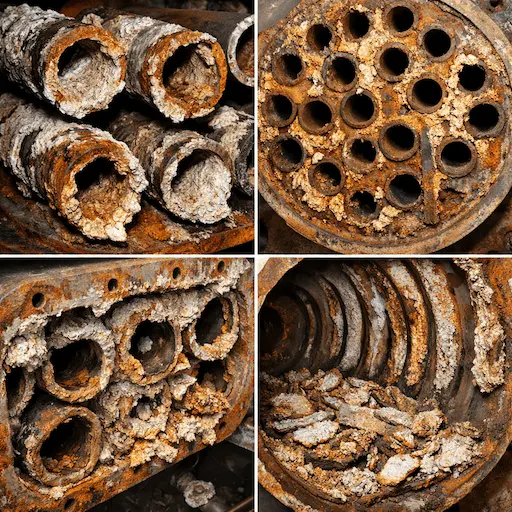
Visible scale found during any inspection (even a small amount) is a clear sign that current water treatment is not fully controlling hardness, whether due to a pretreatment issue, insufficient scale inhibitor dosing, or both. Scale should never be treated as a cosmetic issue to note and move past; it is direct evidence of a mechanism that will continue building until the underlying cause is addressed.
It is worth resisting the temptation to mentally file a thin scale layer as "not bad enough to worry about yet." Scale grows from whatever thickness it is currently at, and the insulating effect on heat transfer is not linear: a deposit that has doubled in thickness since the last inspection can represent a meaningfully larger efficiency and overheating risk than the same-looking thin layer represented a year earlier, even though both might be described the same way in an inspection note that just says "some scale present."
Rust-Colored Water
Rust-colored or discolored water in blowdown, condensate, or during inspection points to iron oxide corrosion products somewhere in the system. Because these particles can also settle and build into deposits elsewhere, rust-colored water is worth investigating immediately rather than dismissed as a one-time occurrence, particularly if it appears repeatedly or after any change to feedwater source or treatment chemicals.
A single instance of rust-colored water right after a maintenance shutdown, when piping has been disturbed and loose scale or corrosion products can dislodge, is generally less concerning than the same discoloration appearing during normal steady-state operation with no recent mechanical work. Distinguishing between these two situations, and not simply logging every rust-colored blowdown as equally routine, helps identify which occurrences genuinely warrant an oxygen and pH review.
Tube Overheating
Overheated tubes (identifiable by discoloration, bulging, or, in more advanced cases, visible warping) are a direct consequence of scale or deposits reducing heat transfer efficiency at that specific location. Because tube overheating is a precursor to tube failure rather than a separate, unrelated symptom, discovering it during an inspection should trigger both a water chemistry review and a closer look at the specific deposit causing the localized heat buildup.
It is worth noting that tube overheating does not require years to develop once a significant deposit is present: under the wrong combination of deposit thickness and firing rate, meaningful metal temperature excursions can occur within a single operating cycle. This is part of why routine inspection during planned shutdowns is treated as a non-negotiable step by experienced operators rather than an optional extra performed only when time allows.
Corrosion
Visible corrosion on tubes, drums, or piping (whether general thinning or localized pitting) indicates that oxygen control, pH control, or both are not adequately managed. Corrosion found on the outside of accessible piping is often a useful indicator of what may also be happening on internal surfaces that cannot be directly inspected during normal operation.
External corrosion is sometimes dismissed as a housekeeping or insulation issue rather than connected back to internal water chemistry, particularly when it appears on piping jacketed with insulation that has become wet from an unrelated leak. While external moisture ingress is a genuine and separate cause worth ruling out, it should not be assumed by default: a quick internal water test costs little compared to the risk of misattributing a genuine internal corrosion signal to an external cause.
Sludge
Excessive sludge found during bottom blowdown suggests either insufficient dispersant dosing, blowdown that is too infrequent, or a feedwater hardness level exceeding what the current pretreatment and chemical program were designed to handle. Sludge is easier to manage than scale, but only if blowdown practices actually remove it before it has a chance to bond onto surfaces.
Boiler Shutdown
An unplanned boiler shutdown (whether triggered by a safety interlock, a tube failure, or a low-water condition linked to fouled level control instrumentation) is the point at which warning signs have gone unaddressed long enough to interrupt production. Every unplanned shutdown is worth a root-cause review that includes water chemistry, not just the immediate mechanical trigger, since water-related deposits and corrosion are frequently a contributing factor even when the immediate cause looks purely mechanical.
A level control instrumentation fault, for example, is usually logged simply as an instrumentation failure. But if the sensing line or float chamber had been quietly accumulating scale or sludge for months beforehand, the water chemistry conditions that allowed that buildup are just as much a root cause as the failed component itself, and without addressing them, a replacement sensor is likely to foul again on the same timeline.
Preventive Maintenance
The single most effective way to avoid discovering these signs the hard way is a maintenance routine that catches them early: scheduled water testing, regular blowdown verification, periodic internal inspection during planned shutdowns, and a chemical dosing program that is reviewed whenever feedwater or load conditions change. Preventive maintenance costs are consistently smaller than the combined cost of emergency repairs, lost production, and expedited parts that follow an unplanned failure.
For facilities without a dedicated water treatment specialist on staff, an external technical partner performing a periodic review (quarterly or semi-annually depending on boiler criticality) provides much of the same benefit as continuous in-house monitoring, provided the facility's own daily testing routine is maintained consistently between visits. The combination of daily operator testing and periodic specialist review tends to catch problems earlier than either one alone.
Corrective Actions
When one or more of these signs is identified, the appropriate response depends on severity, but a consistent starting point is: test current water chemistry against target ranges, inspect for visible scale, corrosion, or sludge if the boiler can be safely opened, and review recent changes to feedwater source, load, or dosing before assuming the treatment chemical itself is at fault. In many cases the chemical program is fine and the actual cause is a pretreatment or dosing equipment issue upstream of it.
Inspection Checklist
- Track fuel consumption per unit of steam produced, not just total fuel cost, to catch efficiency loss early.
- Test boiler water pH, TDS/conductivity, and chemical residual on a fixed schedule.
- Inspect accessible tubes, drums, and piping for scale, corrosion, or discoloration during every planned shutdown.
- Check blowdown water and condensate for discoloration or unusual appearance.
- Review bottom blowdown for excessive sludge volume.
- Investigate any unplanned shutdown with a root-cause review that includes water chemistry.
Conclusion
None of these signs, taken alone, necessarily means a boiler is in immediate danger, but together, and especially if more than one appears at the same time, they indicate that the current water treatment program is not fully controlling the mechanisms it is meant to control. Catching these signs during routine inspection and testing, rather than waiting for a shutdown to force the issue, is what keeps a boiler running reliably for its full intended service life.
Call to Action
If your facility is seeing any of these warning signs, Carbolabs Corporation's technical team can review your boiler condition and water test history and recommend next steps. Contact our engineers for a technical assessment.