Condensate return is one of the best economic decisions available to a boiler operator: it is the purest water in the entire steam system, and reusing it saves treated makeup water, chemical, and the fuel needed to heat cold feedwater from scratch. It is also, ironically, one of the most corrosion-prone parts of the system, precisely because it is so easy to assume that "pure" water can't cause problems. This guide covers why condensate piping corrodes, the two dominant mechanisms behind it, and the practical program that controls both.
Why Condensate Return Matters
Condensate is water that has already been treated, heated, and turned into steam, and recovering it and returning it to the boiler avoids paying twice for the same water and the same fuel. Facilities with high condensate return rates typically see meaningfully lower fuel and makeup water costs than facilities that discharge condensate rather than recovering it. This is exactly why condensate return is worth protecting properly rather than treating it as a secondary afterthought behind the boiler itself.
There is also a water-treatment-quality argument for maximizing condensate return, separate from the cost savings: condensate arrives with very low hardness and dissolved solids compared to fresh makeup water, since it has already been through the boiler's steam separation process. A higher condensate return percentage generally means the boiler is being fed a larger proportion of naturally low-TDS water, which in turn reduces the blowdown rate needed to hold TDS within range. Protecting the condensate return system, in other words, pays off twice: once in direct fuel and water savings, and again indirectly through easier boiler-side water chemistry control.
Why Condensate Piping Corrodes
It is a common and reasonable-sounding assumption that condensate, being nearly pure water, should be the least corrosive water in the entire system. In practice it is often the opposite, because condensate corrosion is driven less by what is dissolved in the water and more by two specific gases that travel with the steam and then dissolve into the condensate as it cools: carbon dioxide and, in some parts of the system, oxygen.
This is precisely why condensate piping is frequently made from carbon steel or copper without the same scrutiny given to the boiler's own pressure parts, and why corrosion here is sometimes discovered later than it should be: the underlying assumption that "it's just clean water" quietly removes condensate return from the same level of routine testing and inspection that boiler water receives, even though the corrosion risk is real and, in the case of carbonic acid, essentially guaranteed to occur to some degree wherever alkalinity is present in the feedwater.
Carbonic Acid Corrosion
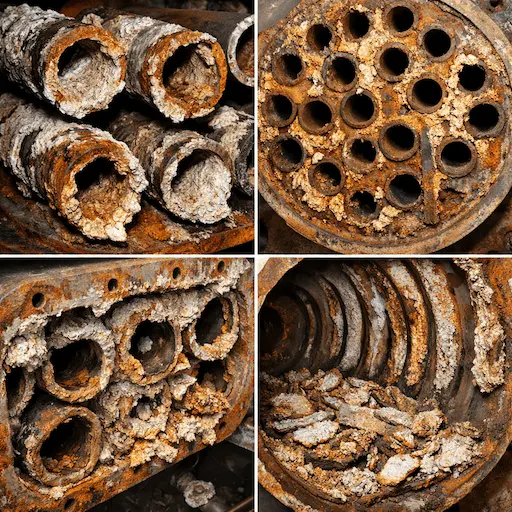
Carbon dioxide does not usually enter a boiler system as CO2 directly. It forms when bicarbonate and carbonate alkalinity present in feedwater breaks down under boiler heat and pressure, releasing CO2 gas that travels with the steam rather than staying behind in the boiler water. Once that steam condenses in piping, traps, and heat exchangers, the CO2 redissolves into the condensate and forms carbonic acid, a weak acid but a persistent one, that lowers condensate pH and steadily attacks unprotected steel and copper piping over time. Because this process repeats every time steam condenses, carbonic acid corrosion is a chronic, ongoing mechanism rather than a one-time event, which is why it shows up as gradual pipe wall thinning rather than a sudden failure.
Carbonic acid attack tends to concentrate at specific points in the piping network rather than spreading evenly, because CO2 gas behaves differently from steam as it travels through the system: it tends to accumulate at low points, dead legs, and areas where condensate collects and sits rather than flowing continuously. This is one of the reasons two facilities with nominally similar feedwater alkalinity can see very different condensate corrosion severity: piping layout and how well condensate is drained at low points matters just as much as the underlying water chemistry.
Oxygen Corrosion in Condensate Lines
Oxygen can enter the condensate system in ways that are easy to overlook: air drawn in through a vacuum condition in the piping, air entrained at a leaking pump seal, or oxygen carried over from an incompletely deaerated feedwater supply. Unlike carbonic acid's broad, gradual attack, oxygen corrosion in condensate lines tends to produce localized pitting, the same mechanism that makes oxygen attack so dangerous inside the boiler itself. Pitting in a condensate line is arguably more likely to go unnoticed for longer, since these lines are typically less closely monitored day to day than the boiler itself.
A vacuum condition severe enough to draw in outside air can develop quietly in condensate return piping whenever steam condenses faster than it is being replaced (for example, right after a sudden drop in steam demand), creating exactly the kind of intermittent air-ingress event that is easy to miss unless someone is specifically looking for it. Facilities that have unexplained, recurring pitting in a particular section of condensate line are often looking at a vacuum-related air ingress point rather than a general water chemistry issue, which is why isolating the location of the pitting matters as much as confirming that pitting is happening at all.
Where Condensate Corrosion Shows Up First
| Location | Common Symptom | Usual Driver |
|---|---|---|
| Steam traps and low points in piping | Localized wall thinning, leaks | Carbonic acid (CO2 concentrates at condensate low points) |
| Pump suction and seal areas | Pitting near the seal | Air ingress / oxygen |
| Return lines after long horizontal runs | General thinning along the pipe | Carbonic acid, extended contact time |
| Heat exchanger tubes on the condensate side | Pinhole leaks | Oxygen pitting or carbonic acid, depending on design |
Neutralizing and Filming Amines
Two distinct chemistries are used to protect condensate systems, and they work in different ways. Neutralizing amines are volatile compounds that travel with the steam and dissolve into the condensate, directly raising its pH to neutralize the carbonic acid before it can attack the pipe wall. Filming amines instead form a thin, continuous protective layer on the metal surface itself, physically separating the pipe wall from the corrosive condensate regardless of its pH. Many condensate treatment programs use a combination of the two rather than relying on just one mechanism, since neutralizing amines address the water chemistry directly while filming amines add a physical barrier that also helps in areas where pH control alone struggles to reach evenly, such as complex piping geometries.
Dosing point selection matters for both chemistries. Neutralizing amines are typically fed into the steam header or boiler feedwater so they travel with the steam and reach the condensate system broadly; filming amines can be fed similarly, but their protective effectiveness depends on achieving even film coverage, which is part of why some systems benefit from multiple injection points rather than a single dosing location feeding an extensive, branching piping network.
Testing Condensate Quality
Condensate pH and iron content are the two most direct indicators of how well a condensate treatment program is working. A condensate pH trending toward the acidic side of the target range is an early sign that carbonic acid protection needs review, while elevated iron in returned condensate is a direct indicator that corrosion is actively occurring somewhere in the return system, even if the exact location hasn't been identified yet. Both should be tested on a routine schedule rather than only when a leak or visible problem prompts an investigation.
Testing at more than one point in the condensate return network (rather than only where the condensate finally arrives back at the boiler feedwater tank) makes it possible to narrow down where a problem is originating. A facility that only tests condensate quality at the final return point can confirm that corrosion is happening somewhere upstream, but not where, turning every investigation into a search across the entire piping network instead of a targeted check of a specific, already-suspected section.
Corrective Actions When Corrosion Is Found
When condensate corrosion is confirmed (whether through elevated iron, a pH excursion, or a physical leak), the response should address the actual driver rather than just repairing the immediate damage. If iron is elevated and pH is low, the corrective step is almost always reviewing and adjusting neutralizing amine dosing. If pitting is found and pH is within range, the more likely driver is oxygen ingress, which points toward inspecting pump seals, vacuum-prone piping sections, and deaerator performance rather than the amine program. Replacing a corroded section of pipe without addressing which mechanism caused it simply schedules the same failure again on a similar timeline.
It is also worth reviewing whether a recent operational change coincided with the corrosion being discovered, rather than assuming the treatment program itself has simply stopped working. An increase in condensate return volume, a new steam-using process added downstream, or a change in feedwater alkalinity all shift the underlying chemistry the amine program was originally sized for. In many cases the fix is recalculating dosing against the new conditions, not switching to a different chemical entirely.
Maintenance Checklist
- Test condensate pH and iron content on a routine, scheduled basis.
- Review neutralizing and filming amine dosing whenever condensate return volume or steam load changes.
- Inspect pump seals and known vacuum-prone piping sections periodically for air ingress.
- Log condensate test results alongside boiler-side water chemistry, not as a separate, disconnected record.
- Investigate any condensate leak for its underlying cause before simply repairing and moving on.
- Review deaerator performance if oxygen-driven pitting is suspected in the condensate system.
Conclusion
Condensate return is too valuable, economically, to leave unprotected, but protecting it requires recognizing that its main threats, carbonic acid and oxygen, are different from the mechanisms that dominate inside the boiler itself. A condensate program built around correct amine treatment, routine pH and iron testing, and prompt investigation of any leak keeps this part of the system delivering its full economic value instead of quietly becoming a recurring maintenance cost.
The facilities that get the most value from condensate return are consistently the ones that treat it as a full extension of the boiler water program, with its own testing schedule and its own dosing review, rather than as a passive pipe network that simply carries water back to the feedwater tank on its own.
Call to Action
If your facility is seeing condensate leaks, elevated iron, or simply wants a second opinion on its amine program, Carbolabs Corporation's technical team can review your condensate system and recommend a treatment plan. Contact our engineers to get started.