Membrane fouling and scaling are the two most common reasons an RO system underperforms, and both are almost always preventable with the right pretreatment and monitoring in place. Because fouling develops gradually and membranes are hidden inside sealed pressure vessels, many facilities don't notice a problem until permeate flow has already dropped or feed pressure has climbed well above design. This guide covers the distinct types of fouling and scaling that affect RO membranes, why they happen, and the pretreatment and monitoring practices that prevent them.
Types of Membrane Fouling
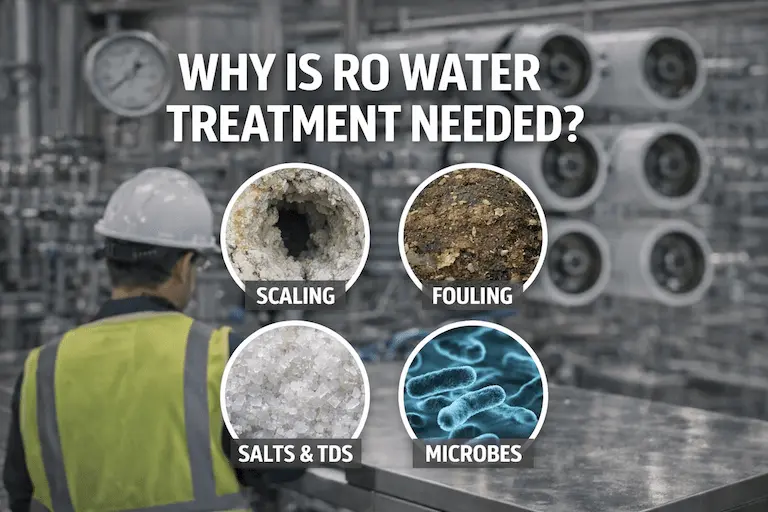
"Fouling" is a broad term covering several distinct mechanisms: scaling from dissolved minerals, particulate and colloidal fouling from suspended solids, organic fouling from dissolved organics, and biofouling from microbial growth, each with different causes and different prevention strategies. Treating all performance decline as one generic problem, rather than identifying which specific mechanism is at work, is one of the most common reasons a facility's corrective action doesn't actually fix the underlying issue.
Calcium Carbonate Scaling
Calcium carbonate scale forms when calcium and bicarbonate ions in the feed water concentrate beyond their solubility limit as water passes through the membrane and dissolved solids build up in the reject stream. It is one of the most common scale types in RO systems fed by hard water sources, and it is also one of the most predictable: its formation can be reliably anticipated from a feed water analysis and prevented with appropriate antiscalant dosing or pH adjustment before it ever becomes a problem.
Calcium Sulfate Scaling
Calcium sulfate scale behaves differently from carbonate scale in an important way: it forms slowly and, once established, is considerably more difficult to remove with standard acid cleaning. This makes prevention especially important for feed waters with elevated sulfate and calcium levels, since a calcium sulfate scaling event that goes unaddressed can cause more lasting membrane damage than a comparable carbonate scaling event that is caught and cleaned promptly.
Silica Scaling
Silica scaling is a particular concern because silica scale is notoriously difficult to remove chemically once it forms, often requiring specialized cleaning approaches that standard acid or alkaline cleaners do not effectively address. Feed water with elevated silica levels typically requires a lower recovery rate target, a silica-specific antiscalant, or both, and the maximum safe recovery rate for a silica-rich feed water should always be verified against actual silica concentration rather than assumed from a generic industry figure.
Iron Fouling
Dissolved iron in feed water oxidizes on contact with air or oxidizing agents, forming insoluble iron hydroxide deposits that coat the membrane surface and are difficult to remove once established. Groundwater sources are particularly prone to this issue, and effective iron removal, through oxidation and filtration ahead of the membrane array, is typically required as a dedicated pretreatment step rather than left to the antiscalant program alone, since antiscalants are not generally effective at preventing iron fouling once iron has oxidized.
Organic Fouling
Organic fouling occurs when dissolved and colloidal organic matter in the feed water adsorbs onto the membrane surface, forming a fouling layer that reduces permeate flow and can also provide a nutrient source for subsequent biological growth. Surface water sources typically carry higher organic loading than groundwater, making organic fouling a more common concern for facilities drawing from rivers, canals, or ponds rather than boreholes.
Colloidal Fouling
Colloidal fouling results from fine suspended particles (clay, silt, and similar material) that are too small to be effectively removed by standard media filtration but large enough to accumulate on the membrane surface over time, forming a cake layer that increases resistance to flow. Silt Density Index (SDI) testing is the standard field method for estimating colloidal fouling potential before it becomes a membrane problem, and a consistently high SDI reading is a clear signal that pretreatment needs review.
Biological Fouling
Biological fouling occurs when bacteria and other microorganisms colonize the membrane surface, using dissolved organics and nutrients in the feed water to grow and reproduce. Unlike scaling, which is a purely chemical process, biofouling is a living process that can continue to develop and spread even after the immediate feed water conditions that triggered it have changed, which is part of why it can be more persistent than other fouling types once established.
Biofilm Formation
Biofilm is the structured, self-protecting layer microorganisms build once established on a surface, and it is considerably more resistant to biocide exposure than free-floating bacteria in bulk water. This is the central challenge of biofouling control: a disinfection program that only addresses bulk water microbial counts, without specifically disrupting or removing established biofilm, will consistently underperform against the actual fouling occurring on the membrane surface.
Feed Water Pretreatment
Because each fouling mechanism has a different root cause, effective pretreatment is really a set of targeted countermeasures: media filtration and coagulation for particulates, iron and manganese removal where present, disinfection and periodic shock treatment for biological control, and antiscalant dosing for the scaling-forming minerals identified in the feed water analysis. Pretreatment designed around a generic assumption rather than the site's actual feed water chemistry is one of the most common reasons a well-selected membrane still underperforms.
SDI (Silt Density Index)
SDI is measured by passing feed water through a standardized 0.45-micron filter and tracking how quickly the filter's flow rate declines, providing a practical field indicator of colloidal fouling potential without requiring laboratory analysis. Most membrane manufacturers publish a maximum recommended SDI for their elements, and feed water consistently above that threshold indicates pretreatment upgrades are needed before long-term membrane performance can be expected to hold up.
Antiscalant Programs
A properly selected and dosed antiscalant interferes with crystal formation and growth, keeping scale-forming minerals in solution well beyond their normal solubility limit under the specific pH, temperature, and concentration conditions inside the membrane array. Antiscalant selection should be matched to the specific scaling constituents identified in the feed water: a generic antiscalant dosed at a generic rate is a common reason facilities experience scaling despite believing they already have a chemical program in place.
Chemical Cleaning
Chemical cleaning (Cleaning-In-Place, or CIP) uses acidic or alkaline cleaning solutions circulated through the membrane array to dissolve or dislodge accumulated foulants, restoring performance closer to the membrane's original condition. Cleaning solution selection depends on the specific foulant type identified: acidic cleaners are generally effective against mineral scale, while alkaline cleaners with appropriate surfactants are generally more effective against organic and biological fouling, which is why correctly identifying the fouling mechanism matters before cleaning, not just after it fails to help.
CIP Systems
A dedicated CIP system (typically a tank, circulation pump, cartridge filter, and heater) allows cleaning solutions to be prepared, heated to the appropriate temperature, and circulated through the membrane array without needing to disconnect elements from their pressure vessels. Facilities operating multiple RO trains benefit significantly from having CIP capability sized and available on-site, since delayed cleaning while waiting for equipment or contractor availability allows fouling to progress further and become harder to reverse.
Distinguishing Fouling from Scaling in Practice
Operators often use "fouling" and "scaling" interchangeably, but the distinction matters for choosing the right corrective action. Scaling is a chemical precipitation process driven by exceeding a mineral's solubility limit, and it responds predictably to antiscalant dosing and recovery rate adjustment. Fouling (whether from particulates, organics, or biological growth) is a physical or biological accumulation process that responds instead to pretreatment filtration, disinfection, or biofilm-dispersing chemistry. Applying a scaling-focused fix, such as increasing antiscalant dose, to what is actually a biofouling problem will not resolve it, and can waste time while the underlying issue continues to develop.
A useful diagnostic habit is to review where in the array performance decline first appears. Scaling tends to concentrate toward the tail end of an array, where dissolved solids are most concentrated after multiple stages of water removal. Particulate and colloidal fouling, by contrast, typically shows up first at the lead elements, where the feed water first contacts the membrane surface before any filtration effect from upstream elements. This pattern is not a substitute for direct testing, but it is a useful first clue when deciding where to focus a more detailed investigation.
Root Cause Verification
When a membrane is pulled for inspection or sent for autopsy after a suspected fouling event, a qualified laboratory can identify the specific foulant through visual inspection, weight-loss-on-ignition testing, and elemental or microbiological analysis of the deposit. This step is worth the cost for a recurring or severe fouling problem, since it replaces guesswork with a confirmed root cause, and a corrective pretreatment change made without this confirmation runs a real risk of addressing the wrong mechanism while the actual cause continues unaddressed.
Monitoring Tools and Data Normalization
Raw operating data (feed pressure, differential pressure, permeate flow, and conductivity) is directly affected by feed water temperature and applied pressure, which change throughout the day and across seasons independent of any fouling or scaling occurring inside the membrane. Comparing raw values from a summer reading against a winter reading, without normalizing both to a common reference temperature and pressure, can make membrane performance appear to be declining when it is not, or mask a genuine decline that is being offset by favorable temperature conditions. Most RO system control platforms include built-in normalization calculations for exactly this reason, and reviewing normalized rather than raw trend data should be standard practice for any facility serious about catching fouling early.
Preventive Maintenance
- Track normalized permeate flow, differential pressure, and salt rejection continuously to catch fouling trends early.
- Test feed water SDI regularly, especially after any change in raw water source or season.
- Verify antiscalant dosing rate against actual feed water conditions, not just the original design rate.
- Schedule CIP cleaning based on performance data trends rather than waiting for a severe decline.
- Maintain iron removal and disinfection pretreatment stages according to their own service schedules.
Troubleshooting
When performance declines, the practical troubleshooting sequence is to first normalize the data against temperature and pressure to rule out a measurement artifact, then compare the pattern against known fouling signatures: a sharp differential pressure rise localized at the lead elements often points to particulate or colloidal fouling, while a broader decline in salt rejection across the array is more consistent with scaling or biofouling. This pattern recognition, informed by dated historical records, is usually more reliable than guessing based on a single data point.
Conclusion
Membrane fouling and scaling are not random events: each type has an identifiable cause rooted in specific feed water characteristics, and each is preventable with pretreatment and monitoring matched to those characteristics. Facilities that invest in a proper feed water analysis, targeted pretreatment, and consistent trend monitoring rarely face severe fouling events, while those relying on generic assumptions are the ones repeatedly caught off guard by premature membrane failure.
Call to Action
Carbolabs Corporation's technical team can review your feed water analysis and current antiscalant program to identify your system's specific fouling and scaling risks. Talk to our engineers about protecting your RO membranes.