Antiscalant dosing is one of the least visible parts of running an RO system, and also one of the most consequential: get it right and membranes run for years without a scaling incident; get it wrong and even a well-designed pretreatment train can't prevent premature scale formation. This guide covers how antiscalants actually work, how dosing systems are set up and monitored, and the practical mistakes that cause otherwise sound antiscalant programs to fail.
Importance of Antiscalant Dosing
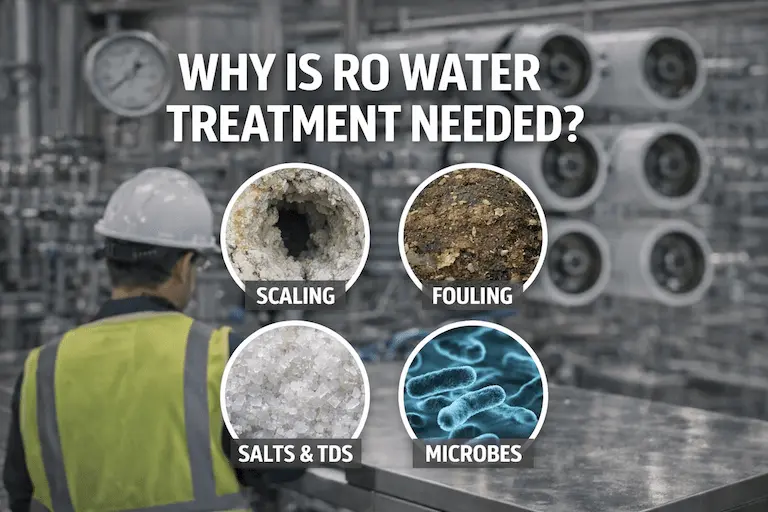
As feed water passes through an RO membrane, dissolved minerals concentrate in the reject stream, often reaching concentrations well above their normal solubility limit in the original feed water. Without antiscalant dosing, these minerals would precipitate as scale on the membrane surface, reducing permeate flow, damaging rejection performance, and shortening membrane life. Antiscalant dosing is what allows a system to operate at commercially practical recovery rates without scaling, rather than being limited to the very low recovery rate at which no scaling would occur naturally.
How Antiscalants Work
Antiscalants work primarily through crystal modification and dispersancy rather than by simply preventing dissolved minerals from concentrating. They interfere with the early stages of crystal nucleation and growth, keeping developing crystals small and dispersed in solution rather than allowing them to grow large enough to settle out and adhere to the membrane surface. This is why antiscalants can allow a system to operate above a mineral's theoretical solubility limit (a state referred to as supersaturation) without scale actually forming, provided the antiscalant is correctly matched and dosed for that specific condition.
Common Antiscalant Types
Antiscalant chemistries generally fall into a few families (phosphonates, polyacrylates, and polymaleic acid-based products among the most common), each with different effectiveness against specific scale types such as calcium carbonate, calcium sulfate, and silica. No single antiscalant is universally effective against every scaling constituent, which is why antiscalant selection should always be based on the specific feed water analysis for the site rather than a default product choice or price alone.
Dosing Pumps
Antiscalant is introduced using a metering pump, typically a diaphragm or peristaltic type, sized to deliver a precise and consistent dose proportional to feed water flow. Dosing pump accuracy should be verified periodically against the actual delivered volume, not just assumed from the pump's control setting, since pump wear, tubing degradation, or air entrainment in the suction line can all cause actual dose to drift from the intended setpoint without any alarm being triggered.
Chemical Injection Points
Antiscalant is normally injected upstream of the cartridge filters and high-pressure pump, allowing adequate mixing and reaction time before feed water reaches the membrane array. Injection point placement matters: dosing too close to the membrane array can leave insufficient contact time for the antiscalant to act, while a poorly mixed injection point can create localized concentration inconsistencies even when the overall dose rate is correct.
Feed Water Monitoring
Because antiscalant dosing is calculated against specific feed water hardness, alkalinity, silica, and sulfate levels, any meaningful change in feed water source or quality (a new well, a seasonal shift in surface water chemistry, or an upstream process change) can invalidate the existing dosing calculation. Feed water should be retested periodically, not just at initial system design, so the antiscalant program continues to match what the membrane is actually seeing.
Recovery Optimization
Antiscalant dosing and recovery rate are directly linked: a stronger or better-matched antiscalant program can often support a higher recovery rate on the same feed water, reducing reject volume and feed water consumption. However, recovery rate should be increased incrementally and verified against actual performance data, not pushed to a theoretical maximum in one step, since the margin between a supported recovery rate and a scaling incident can be narrower than it appears on paper.
Membrane Protection
Beyond preventing visible scale, correct antiscalant dosing protects the membrane's long-term rejection performance and mechanical integrity, since scale formation (even minor, intermittent scaling that doesn't trigger an obvious alarm) causes cumulative damage that shortens overall membrane life. Consistent dosing accuracy over the full life of a membrane element matters more than any single dosing event.
Conductivity Monitoring
Conductivity monitoring, both on feed water and permeate, provides an indirect but continuous check on overall system performance and is typically the first parameter that shows a deviation if something in the pretreatment or dosing chain has changed. A conductivity trend should always be read alongside pressure and flow data rather than in isolation, since conductivity alone doesn't distinguish between a dosing problem, a membrane integrity issue, or simple feed water variation.
pH Adjustment
Some antiscalant programs are paired with pH adjustment, either to improve antiscalant effectiveness against certain scale types or to reduce corrosion risk within the system's metallic components. pH adjustment chemistry and antiscalant chemistry can interact, so any change to one should be reviewed against the other rather than adjusted independently, particularly since some antiscalant products have a specific effective pH range outside of which their performance degrades.
SDI Monitoring
While SDI (Silt Density Index) is primarily associated with particulate fouling rather than scaling, it remains a useful complementary check for any RO dosing program, since a feed water source that has shifted enough to change its scaling potential has often shifted its particulate loading too. Reviewing SDI alongside the antiscalant program provides a more complete picture of pretreatment adequacy than either check alone.
Daily Water Testing
A practical daily or shift-based testing routine (feed and permeate conductivity, pH, and a visual check of the dosing pump and chemical tank level) catches the majority of dosing-related issues before they progress to a scaling incident. This routine testing is inexpensive compared to the cost of a scaling event and subsequent membrane cleaning or replacement, and it should be treated as a non-negotiable operational discipline rather than an optional extra.
Verifying Dose via Residual Testing
Beyond checking that the metering pump is running, many antiscalant suppliers offer a residual test kit that measures actual antiscalant concentration in the reject stream, providing direct confirmation that the intended dose is reaching the membrane array rather than being lost to a leak, blockage, or miscalibrated pump. Residual testing closes a gap that pump-setting verification alone cannot: a pump can be running correctly while the actual chemical never reaches the injection point due to a separate line blockage or a degraded check valve, and residual testing is what catches this kind of silent failure before it results in scaling.
Compatibility with Other Water Treatment Chemicals
Antiscalants are sometimes dosed alongside other pretreatment chemicals such as chlorine or other oxidizing biocides, and not every antiscalant formulation is compatible with every oxidizer: some phosphonate-based antiscalants, for example, can be degraded by strong oxidizing conditions, reducing their effectiveness even though the dosing pump is delivering the correct volume. Any time a new pretreatment chemical is introduced or an existing one is changed, the antiscalant supplier should be consulted to confirm continued compatibility rather than assuming the existing program is unaffected.
Seasonal and Source Changes
Facilities drawing feed water from surface sources often see meaningful seasonal shifts in hardness, alkalinity, and turbidity between dry and wet seasons, while facilities with multiple wells may draw from a different source depending on demand or well availability. Both situations can shift the feed water chemistry the antiscalant program was originally designed around, and a dosing program that was correctly matched at commissioning can quietly become inadequate months later if feed water is not periodically retested against the original design assumptions.
Common Dosing Mistakes
- Continuing to dose at the original design rate after feed water quality has changed, without re-verifying against current conditions.
- Assuming the metering pump is delivering its set dose without periodically verifying actual delivered volume.
- Using a generic antiscalant product without confirming its effectiveness against the site's specific scaling constituents.
- Increasing recovery rate without a corresponding review of whether the existing antiscalant dose still supports it.
- Treating chemical tank level checks as optional rather than part of the routine daily testing sequence.
Documentation and Recordkeeping
Keeping dated records of dosing rate, pump calibration checks, residual test results, and any feed water retesting is what turns a dosing program from an assumption into something that can actually be verified and defended if a scaling event does occur. A facility with clear records showing consistent dosing and periodic verification is in a materially stronger position to identify what changed when troubleshooting an unexpected scaling incident, compared to one relying on memory or informal notes.
These records also make handovers between operators or shifts far more reliable. A logbook that records only "chemical topped up" without dose rate, feed water conditions, or test results attached provides little diagnostic value later, whereas a structured log with consistent fields makes it possible to reconstruct exactly when a dosing program was last verified correct and what changed since.
Chemical Storage
Antiscalant concentrates should be stored according to the manufacturer's safety data sheet, typically in a covered, temperature-moderate area away from direct sunlight and incompatible chemicals, since some antiscalant formulations can degrade in performance if stored improperly for extended periods. Dosing tanks and day tanks should be inspected periodically for degradation, contamination, or crystallization at the tank walls, which can indicate a storage condition issue rather than a dosing calculation problem.
Safety Guidelines
Antiscalant concentrates are generally mild compared to many industrial chemicals but should still be handled with appropriate personal protective equipment as specified in the product's safety data sheet, since concentrated exposure can still cause skin or eye irritation. Dosing pump maintenance should always follow lockout procedures for the pump, and any spill should be contained and cleaned according to the facility's chemical spill response procedure rather than improvised in the moment.
Conclusion
Antiscalant dosing is not a "set it and forget it" chemical program: it is an ongoing discipline that depends on accurate feed water data, verified dosing pump performance, and routine testing to remain effective as conditions change over time. Facilities that treat antiscalant dosing with the same rigor as any other critical process parameter consistently avoid the scaling incidents that catch less disciplined operations by surprise. The cost of a proper dosing program (residual testing, pump verification, and periodic feed water retesting) is consistently small compared to the cost of a scaling-damaged membrane element, which makes this one of the more clearly justified recurring investments in RO system operation.
Call to Action
Carbolabs Corporation's technical team can review your feed water analysis and current antiscalant program to confirm your dosing rate and chemical selection are correctly matched to your system. Contact our engineers for a dosing program review.